Your Robot Coworker Is Still a Pilot

Built, shipped, installed, working: four counts, quoted as one. Almost nobody publishes the fourth.
Built, shipped, installed, working: four counts, quoted as one. Almost nobody publishes the fourth.
The robot that supported 30,000 cars
In February, BMW published the results of a pilot at its plant in Spartanburg, South Carolina. A humanoid robot made by Figure had been lifting sheet metal parts into a welding cell, ten-hour shifts, Monday to Friday.
The release is precise about what happened. The robot moved more than 90,000 components. It covered approximately 1.2 million steps. It ran for around 1,250 operating hours. Within ten months, in BMW’s words, it supported the production of more than 30,000 BMW X3s.1
Four numbers, and not one of them counts robots. BMW’s release refers throughout to “the robot Figure 02”, in the singular, and never states how many were on the floor. I went looking for that figure and could not find it in the company’s own words. Secondary coverage says two. BMW does not say two, or any other number, which is why this piece will not say two either.
What travelled was the 30,000. It became a headline about physical AI’s return on investment, filed under the shorthand that a fleet of humanoids had helped build 30,000 cars. The number is true. BMW published it. The thing it appears to prove, that humanoid robots are now doing meaningful volumes of industrial work, is a claim the number does not make and BMW never made either. The 30,000 is the output of a car line that was running before the robot arrived, and the figure isolates nothing the robot added to it. The release says the robot supported that production rather than performed it.
BMW’s own framing is careful in the same way. The release presents Spartanburg as a completed pilot and announces the next one, at Leipzig, where it says it will test “a humanoid robot” in battery assembly. Singular again, and again no number.
This is the ordinary condition of robot numbers right now. They are almost all real, sourced, and published by serious organisations, and they are routinely answers to a different question than the reader thinks is being asked. The gap has a price. It separates an industry running pilots and demonstrations from one with a standing robot workforce, and a bet sized for the second when the evidence supports only the first is how money gets lost. When a number is about to move a decision, the rung it sits on is the decision.
Four words that are not synonyms
There are four separate quantities hiding behind most robot statistics, and they sit on a ladder.
A robot can be built, meaning it exists and has come off a production line. It can be shipped, meaning it has left the manufacturer and been delivered to somebody who paid for it. It can be installed, meaning it is physically in place at a site and wired into whatever it is meant to do. And it can be working, meaning it is productively doing paid work with limited routine human intervention.
The first three mostly nest, give or take a manufacturer that installs its own units without shipping them anywhere. The fourth is a different kind of question. Built, shipped and installed all ask where the robot is. Working asks what it is doing, and that drags in how much of the time, under how much supervision, at a task somebody would pay a person to do. It is a stricter line than the first three and a blurrier one, which is exactly why it is the rung that goes uncounted.
The examples are easy to feel. A robot in a crate in a warehouse has been built and shipped and is neither installed nor working. A robot in a university lab, bought so that a doctoral student can test a grasping algorithm on real hardware, has been built, shipped and installed, and is doing exactly what its buyer wanted while producing nothing anyone would call labour. A robot standing in a hotel lobby greeting guests has cleared the same three rungs, and whether it is working depends on what you think a lobby greeter produces.
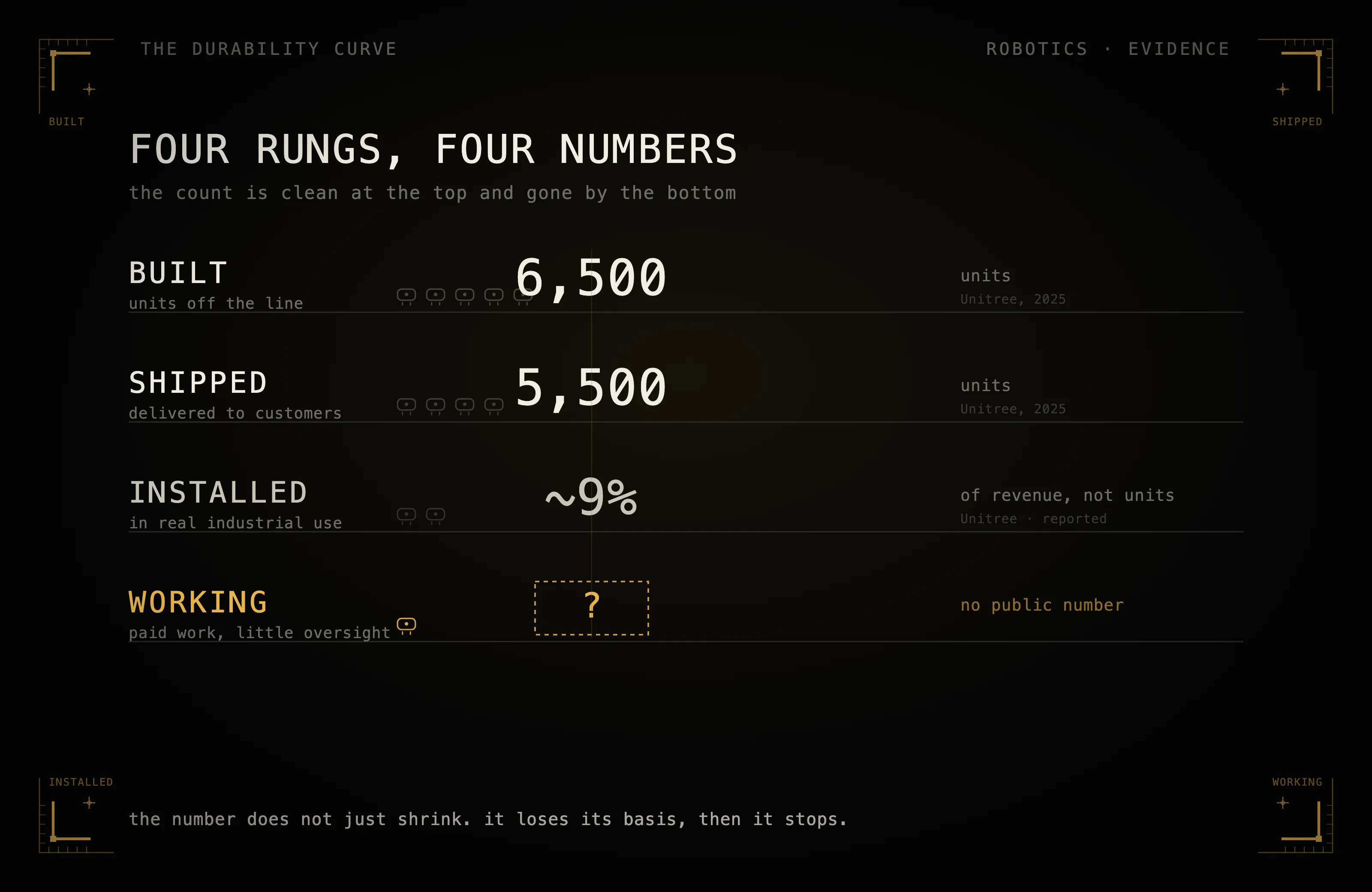
The gaps between rungs are not rounding errors. Unitree, the Chinese manufacturer that ships more humanoids than anyone else, produced more than 6,500 humanoid robots in 2025 and shipped more than 5,500 of them. Those two numbers describe the same company in the same year and differ by 1,000 units. They are adjacent rungs, the closest pair on the ladder, and they still do not match.
Hold that ladder up against Spartanburg. Which rung was BMW’s pilot on? Installed, clearly. Working, arguably, in one welding cell, doing one task. The 30,000 belongs to the X3 production line, which was building cars before the robot arrived and carried on building them after the pilot closed.
The habit is small: when a robot number arrives, ask which of the four words it is attached to. Most coverage will not tell you, and the answer changes the meaning by an order of magnitude.
The company that had to publish a correction
In January, Unitree published a note on its own site because, in its words, “many pieces of misinformation regarding our company’s 2025 shipment volume have been circulating online.”2
Read what the company then does. It gives a shipment figure, more than 5,500 humanoid robots. It gives a separate production figure, total mass-production output above 6,500 units. It defines the first one explicitly as the “quantity actually sold and delivered to end customers, not order volume; the order volume is higher.” And it closes by warning against “directly combining the numbers of different types of robots together for comparison”, because its quadrupeds and its wheeled dual-arm machines are different products with different counts.
That is a manufacturer publishing two distinct numbers for a single year, telling you which is which, telling you a third number exists and is larger, and asking you not to add unlike things together.
There is a third number implied in there. Orders are higher than shipments, and Unitree declines to say by how much. An order runs ahead of the physical count, a commitment to buy rather than a robot that exists yet. It is also the number most likely to be announced, because it arrives first and sounds like traction. The company drew that line without being asked and left the tempting figure unpublished.
The correction is the interesting part. Unitree did not publish this because it wanted to talk about taxonomy. It published because its numbers were being merged in public and the merged version was wrong enough to be worth a correction from the company that made the robots. The most careful counter in humanoid robotics, on this evidence, is the manufacturer, and the imprecision is downstream of it.
What a company publishes when the number is legally binding
So far this is a vocabulary problem. The next document turns it into a structural one.
On 24 June, Agility Robotics announced that it was going public through a $2.5 billion merger with Churchill Capital Corp XI. The announcement was filed with the Securities and Exchange Commission, where a materially wrong number becomes a legal exposure rather than a marketing quibble.
The press release in that filing carries no count of Agility’s robots.3 It reports “more than $300 million of multi-year contracted Digit v5 orders secured to date”, which is money. It reports “deployment commitments across nine customer facilities” and “more than 65,000 hours of operation”, which are sites and hours, and note that the commitments are to deployment rather than deployments already made. It reports a pipeline of over 30 customers, which is logos, and describes a factory “designed to support production of up to 10,000 units annually”, which is the capacity of a building. Dollars, facilities, hours, customers, capacity, and no robots.
The robot count is in the same filing, one exhibit over, in the investor presentation.4 And it is a single unit figure, confined to a footnote that repeats under the same order number wherever it appears. The $300 million, the footnote says, “relates to 1,000 Digit v5 robots with three-year term RaaS contract”. So there is a count, and the count is 1,000.
Read which rung it sits on. The same footnote opens by saying the figure “reflects customer orders for Digit v5, as of May 2026”. 1,000 robots ordered. Not built, not shipped, not installed. Digit v5 had not launched when this was filed, so the order sits before the physical ladder even begins, a contract for robots that do not yet exist, and it is the number a company reaches for first because it arrives first and reads as traction.
Then read the clause most people would skip. The same contract “includes warrants issued to purchaser vesting proportionately to robots deployed”. The buyer’s upside is tied to deployment, and deployment is treated here as a separate event from the order, gated, still ahead, and never given a number. In the one document where the counting is legally accountable, the company publishes the order, structures real money around the deployment, and states the deployment figure nowhere.
The taxonomy is not my imposition on the industry. It is written into a warrant.
Everything else in that presentation confirms the pattern. The projections run “1k units/yr, 5k units/yr, 10k units/yr” across a cost curve, which are production scenarios rather than robots made. A revenue chart scales an “installed base” from 2,500 to 15,000 and marks itself “for illustrative purposes only”. The company says its robots are “currently deployed in customer facilities” and never says how many. One ordered count, a spread of illustrative futures, and a deployed count that the document is built around and declines to give.
This is the part any reader can check without trusting me. The filing is public, both exhibits are on EDGAR, and the footnote takes about a minute to find.
The gradient
Put three companies side by side and a pattern appears that none of them would state on their own behalf.
Unitree is preparing to list on Shanghai’s STAR Market, where a prospectus must disclose sales volumes. Its prospectus reportedly splits humanoid revenue for the first three quarters of 2025 three ways: research and education 73.6 per cent, commercial 17.4 per cent, real industrial work 9 per cent. That split is second-hand, and it is a share of revenue rather than of units,5 so hold it more loosely than the primary figures above.
Held loosely, it is still among the most useful numbers in this piece. The university lab from earlier is not an edge case. Research and education is the largest disclosed source of humanoid revenue at the company that ships more humanoids than anyone else on earth, and industrial work is the smallest of its three markets. The robots are real and the sales are real, and the biggest slice of the money comes from selling them as teaching hardware.
Agility, filing in the United States where no volume disclosure is required, gives one unit number, an order, and describes the rest through hours and facilities.
And Tesla, with no specific obligation to publish an Optimus count, has published none. Its Q2 statements describe installing production lines and starting production soon, and say the first units are for training data collection and further development rather than customers. That characterisation comes from reporting on the earnings materials6 rather than from my own reading of Tesla’s deck, so treat it the same way. Meanwhile the figures that circulate for Optimus, several hundred units, 1,000 units, come from enthusiast sites rather than from Tesla.
Line those three up and the direction is suggestive. Where the law compels volume disclosure, you get unit counts. Where it compels disclosure without specifying volumes, you get proxies. Where nothing compels anything, you get founder posts and adjectives. AGIBOT sits at that last end too: having announced its 10,000th unit produced, it says only that “a significant portion is already active in real-world environments”, and no number is ever attached to the portion.7
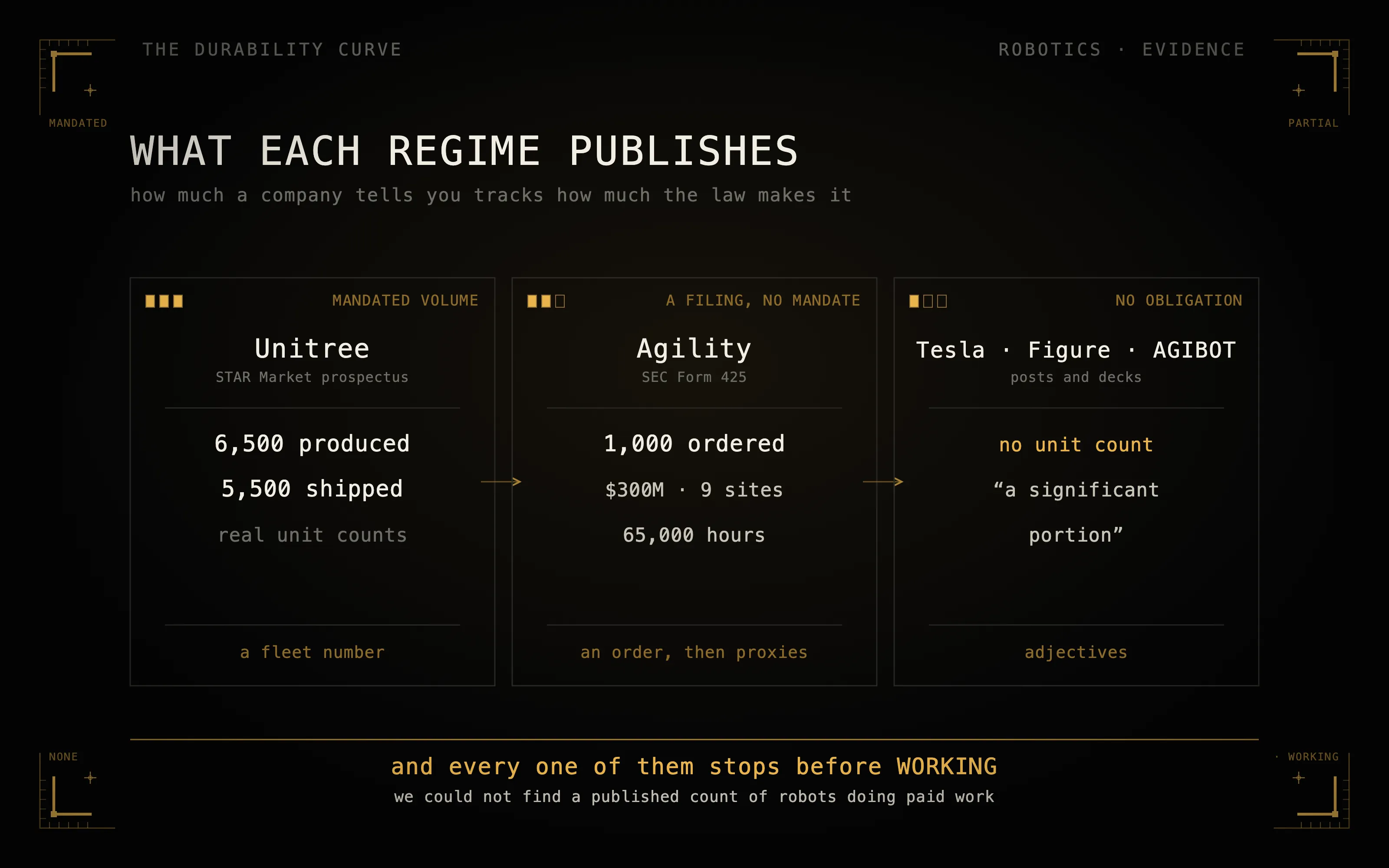
Three companies is not enough to blame the law, and it is not only the law that changes between them. Jurisdiction, company maturity, business model and the purpose of the document all move at once. Treat it as a hypothesis with a use: when a robot number is missing, the disclosure regime is the first place to look for why, and often for where a truer number is hiding.
The rung nobody reaches
The gradient has a ceiling, and the ceiling arrives before the top of the ladder.
Across every source in this piece, company announcements, an SEC filing, an IPO prospectus, a trade body and the press that covers all of them, I could not find a published count of humanoid robots productively doing paid work with limited routine human intervention, the fourth rung as defined earlier. The search returned no such figure at all, from anyone. If you know of one, I would genuinely like to see it, and the claim here narrows accordingly.
The strongest counter-example is not a humanoid company at all. The International Federation of Robotics has counted industrial robots for decades and it is rigorous about a distinction most robot coverage skips. Its World Robotics 2025 report gives 542,000 robots installed in 2024, a flow, the new units added that year. It separately gives operational stock of 4,664,000 units, a level, the accumulated total still in service.8 Those are not two rungs of the same fleet moving from one to the next; they are a year against roughly a decade, and IFR is careful never to let the two be read as one.
That discipline is exactly what makes the ceiling visible. Operational stock is itself an estimate, built on assumptions about how long a robot stays in service, not a direct count of which machines are running. IFR does not report how many of the 4.66 million are producing, versus idle, versus down for maintenance, versus sitting on a line that has since been retired. The most disciplined counting operation in robotics separates the flow from the level, and on utilisation it goes quiet.
There are decent reasons for the silence. Utilisation is commercially sensitive. “Productive” and “with limited intervention” are genuinely hard to define at the boundary, and a company that published a number would then have to defend its definition. I am not claiming anyone is hiding anything, and the piece does not need a motive to stand up. The absence is the fact.
What follows from it is a limit on what anybody can currently know. Every confident statement about how much work humanoid robots are doing in the world is an inference from the rungs below, made by someone who chose the conversion rate themselves.
None of this means the robots are not working. The BMW unit ran 1,250 hours of real work on a live production line, and Agility’s orders are real money with deployment milestones written into the contract. Something is happening on the fourth rung. The claim here is only that its size is the one thing nobody has measured, while a great deal of capital and attention is priced as though the measurement had already come back large. The workforce may well be real. The number that would prove it is not yet on any page.
The next number you read
When the next robot figure arrives, and it will arrive this week, the question to ask is which of the four words it belongs to. Built, shipped, installed, working. The answer is usually recoverable from the original document in under a minute, and it is usually not the rung the headline implies.
Two follow-ons are worth keeping. The first is that the most expensive errors are made of true numbers, because a figure that survives fact-checking can still carry a claim its source never made, and every number in this piece is of that kind. The second is that when a company substitutes hours, sites or capacity for units, the substitution is itself information. It tells you which number that company is prepared to put its name to.
BMW’s four numbers were real. 90,000 components, 1.2 million steps, 1,250 hours, 30,000 cars. The robot count was not among them, the pilot has closed, and the next one is being announced in the singular. Somewhere in that gap is the whole distance between a technology that exists and a technology that works. The first four numbers were easy to find. The one that would settle it, I could not find at all.
What number were you last shown that turned out to be a different rung?

New to The Durability Curve? It is a standing argument about what survives when the tools get powerful and the surface gets cheap. Subscribe for the rest, or start with what survives.
Footnotes
-
BMW Group, “BMW Group to deploy humanoid robots in production in Germany for the first time”, 27 February 2026. The release reports that “within ten months” the robot “moved more than 90,000 components” over “around 1,250 operating hours” and “supported the production of more than 30,000 BMW X3”. It refers throughout to “the robot Figure 02” in the singular and gives no unit count. ↩
-
Unitree Robotics, “Clarification Regarding Unitree’s 2025 Sales Data”, 22 January 2026. “Unitree’s actual shipment volume of humanoid robots exceeded 5,500 units”, against “total mass-production output of 2025 exceeded 6,500 units”. The 5,500 is “the quantity actually sold and delivered to end customers, not order volume; the order volume is higher”. ↩
-
Agility Robotics and Churchill Capital Corp XI, joint press release (SEC Form 425, Exhibit 99.1), 24 June 2026. Reports “$300 million of multi-year contracted Digit v5 orders”, “nine customer facilities”, “65,000 hours of operation” and a factory “designed to support production of up to 10,000 units annually”. No count of robots built, shipped, deployed or working. ↩
-
Agility Robotics, investor presentation (SEC Form 425, Exhibit 99.2), June 2026. The 1,000 figure is a footnote to the orders line: it “reflects customer orders for Digit v5 … relates to 1,000 Digit v5 robots with three-year term RaaS contract, which includes warrants issued to purchaser vesting proportionately to robots deployed”. Digit v5 was pre-launch, and the deck gives no deployed count. ↩
-
The revenue split (73.6 per cent research and education, 17.39 per cent commercial, 9 per cent industrial, first three quarters of 2025) is reported from Unitree’s STAR Market prospectus by 36Kr and TechFlow. I have not read the prospectus itself, filed in Chinese with the exchange. It is a share of revenue, not of units, and the two are not interchangeable when research and industrial units carry different prices. ↩
-
Drawn from coverage of Tesla’s Q2 2026 earnings, not from Tesla’s own deck, which I did not read. ↩
-
AGIBOT, “AGIBOT Reaches 10,000 Units as Real-World Demand for Robots Accelerates”, 30 March 2026. “Of the 10,000 humanoid robots produced, a significant portion is already active in real-world environments.” No number is attached to the portion. ↩
-
International Federation of Robotics, “Global robot demand in factories doubles over 10 years” (World Robotics 2025), September 2025. 542,000 industrial robots installed in 2024; operational stock of 4,664,000 units. ↩