You Only Hold Four Thoughts
Working memory tops out around four things at once. Every leap in human intelligence has come from storing the rest outside your head, and the most advanced AI systems get their gains the same way.
Draft for Substack flagship — Long-Form Article (P1 type). Deploys Analysis — The External Cognition Stack (88 internal refs, 0 prior published citations, knowledge_tier 5 / tier-essence — the highest-tier undeployed analysis in the vault). Angle: the unified design law (externalise state + retrieve selectively) that governs human cognition and machine inference alike, via the Brain to Paper to Vault to Agent-Memory stack and the extended-mind thesis. Differentiated from Substack Article — The Other Half of Compute — 2026-06-02 (which uses the same three papers for compute economics) by staying on the architecture-of-cognition angle, and from the deployed “context is the moat” pieces by foregrounding the extended mind, not the moat.
Pre-publish requirements before ship: clear the three
verification_requireditems, commission cover + field card per durability-curve-visual-system, run Article Pre-Publish Checklist §1-9 + §11, insert real subscribe URL.
You Only Hold Four Thoughts
Working memory tops out around four things at once. Every leap in human intelligence has come from storing the rest outside your head, and the most advanced AI systems get their gains the same way.
This is an analytical framework, not financial advice. Named research claims are referenced to their primary sources in the footnotes.
Try to multiply 47 by 83 in your head. The answer is not the point. Watch what happens while you reach for it. You hold 47, you hold 83, you start on the partial products, and somewhere around the third one the first number goes soft. You reach for a pen, because the problem outgrew the place you were keeping it.
That ceiling is real and it is low. The cognitive scientist Nelson Cowan spent years measuring it and put the number at about four. Not the seven you half-remember from an old paper, but three to five distinct things held in mind at once.1 Four. That is the working capacity of the most sophisticated object in the known universe.
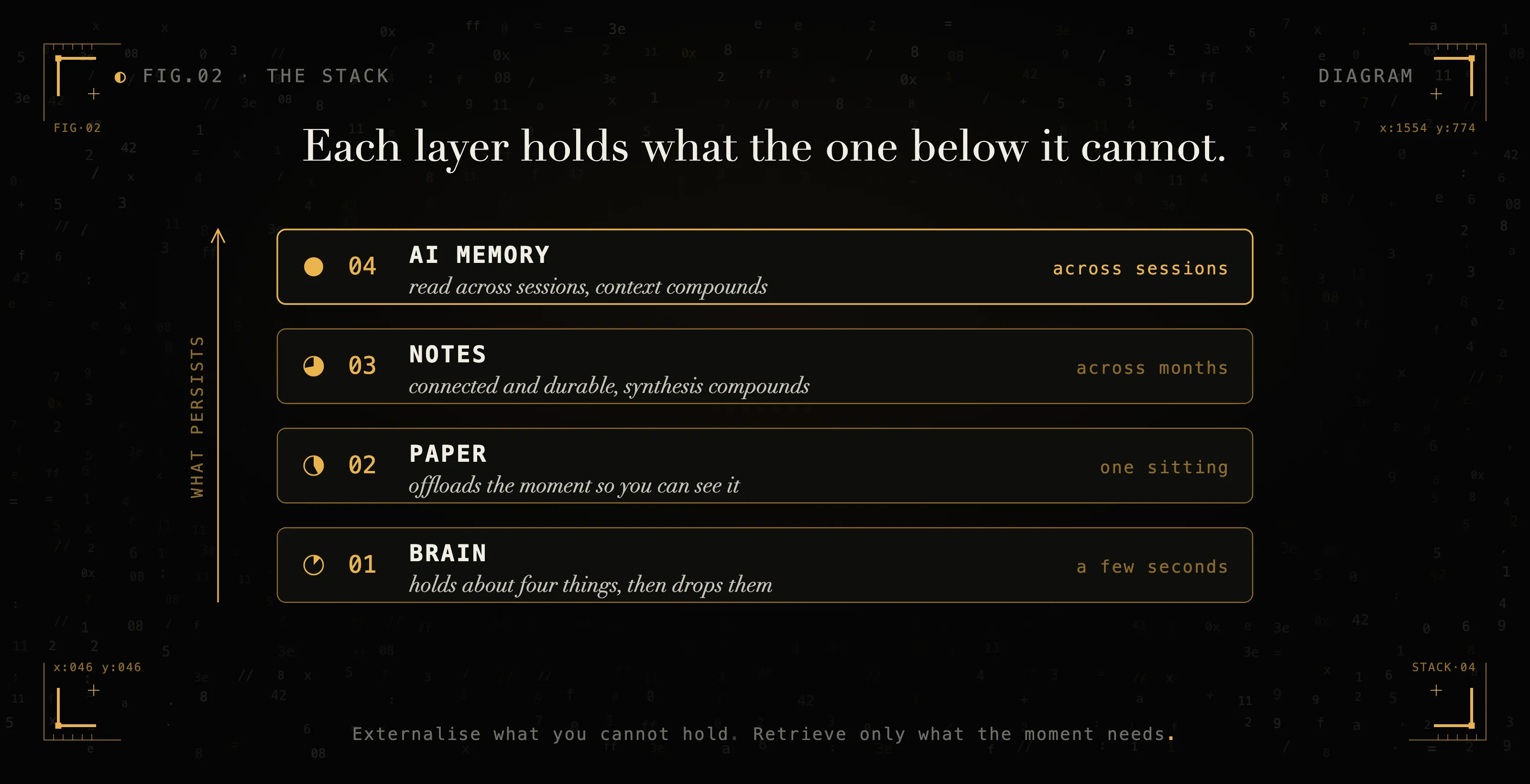
Everything we call getting smarter has been a way around that four. The history of human intelligence is the history of putting thoughts somewhere other than the head, and it runs as a stack, each layer holding what the one below it cannot.
The first rung is paper
Reaching for the pen looks like a small surrender. It is the oldest cognitive upgrade there is. The moment you write 47 above 83 and start stacking partial products, you are thinking about six or seven things at once, because the paper is holding all but the one you are working on.
Justin Sung, who teaches learning for a living, puts it more sharply. Writing is not the thing you do after you have reached clarity. Writing is what produces the clarity.2 The page becomes the workspace where the thought turns real, because your four slots are freed to do the actual reasoning while the page remembers the rest.
This is also why handwriting beats typing. It is far slower than thinking, and that slowness forces you to compress, to decide what is worth the stroke. The friction is not a tax on the process. The friction is the process. A page of notes you struggled to write holds more than a page you copied without resistance.
The page is not a transcript of a finished thought. It is the workspace where the thought becomes possible.
The rung most people never name
In 1998 two philosophers, Andy Clark and David Chalmers, asked where the mind stops and the rest of the world begins, and gave an answer that still unsettles people. The mind, they argued, is not all in the head.3
Their example was a man named Otto, who has Alzheimer’s and carries a notebook everywhere. When Otto wants to go to the museum, he looks up the address in the notebook the way you would retrieve it from memory. The notebook does the job your hippocampus does. Clark and Chalmers argued there is no principled reason to count the notebook as any less a part of Otto’s mind than ordinary memory. Otto and his notebook are a single coupled system. The thinking happens across both.
That sounds like a thought experiment until you notice you are Otto. The phone that holds every number you no longer memorise. The calendar that holds every commitment. The thinking is already distributed across you and the things you store it in. The only open question is how well the storage is built.
The rung that compounds
A single page does not persist, does not connect, and cannot be searched. You solve the multiplication, you throw the page away, and next month you solve it again from scratch. Paper extends the moment. It does not extend across time.
A structured set of notes does. When every thought you have is written as a durable, cross-linked entry, two things happen that a single page cannot. The thought survives, available to a version of you who has forgotten having it. And it connects, so that an idea from March sits one link away from a problem you only encounter in June, waiting to be useful before you knew you needed it.
This is the layer where synthesis becomes possible at a scale no head can hold. No one can keep thirty sources in working memory and find the pattern across them. Four slots cannot do it, and neither can forty. But a system that has been accumulating those sources for months, with the connections already drawn, can surface a synthesis that was never available to anyone thinking alone. The structure does the remembering, which frees the human to do the seeing.
The rung we are building now
For most of history the top of the stack was a human reading their own notes. That is no longer the ceiling. The newest layer is a store of knowledge an AI can read, query, and build on across sessions.
The builders who have lived inside this for a year keep reporting the same thing. One who runs large agent systems put it plainly: the model is the same on day 1 and day 40. The files get richer.4 The capability of the underlying intelligence barely moves over a project. What improves is the accumulated context it can reach, the record of what was tried, what worked, what the operator decided and why. The intelligence is rented and roughly fixed. The memory is owned and compounds.
An AI working from a thin prompt starts every session as a stranger. An AI working from a well-kept store of your decisions starts as a colleague who was in the room last time. The difference is not a better model. It is the same model with the rest of the stack underneath it.
The intelligence is rented and roughly fixed. The memory is owned, and the memory is what compounds.
Why this is one law and not four
This is where a productivity story becomes something larger. The machines climb the same stack you do, for the same reason, using the same move.
A large model also cannot hold everything at once. Its version of the four-slot limit is the memory bandwidth of the chip, and the entire recent history of making models faster is a history of refusing to keep everything hot. FlashAttention rewrote how attention uses memory so the chip stops shuttling the same data back and forth. Key-value caching stores the work already done so it never has to be recomputed. Mixture-of-experts routing keeps a vast model mostly dormant and wakes only the part a given token needs.5 Store state. Reuse it. Activate only what matters now.
That is the same move as paper, notes, and agent memory. Externalise the state you cannot hold, and retrieve only the slice the moment requires. Human cognition scales that way. Machine cognition scales that way. The question “how do I think better” and the question “how do I run a model well” have turned out to be one question with one answer. When two separate problems collapse into the same answer, that answer is usually worth trusting.
One law runs the whole stack: externalise the state you cannot hold, and retrieve only what the moment needs. Brains and models both scale by obeying it.
The trap inside the stack
The law has a failure mode, and it is the one a second-brain enthusiast walks into first. The stack rewards retrieval, not accumulation. The instant you start optimising for the volume of what you store, you have begun to degrade the thing you were building.
A note you never pull back out did no cognitive work. Ten thousand of them do less than a hundred you reach for, because the ten thousand bury the hundred. External cognition only pays off on the way back in. Storing is filing, and filing is not thinking. The discipline that keeps the stack alive is structuring everything you save so a future you, or a future agent, can find the one piece that matters without reading the other nine thousand.
That is also why each rung has to be built in order. Agent memory on top of a disorganised pile of notes inherits the disorder and answers your questions confidently from a mess. The layers compound only when each one is sound. Skip a rung and you do not get the compounding. You get a faster way to retrieve noise.
The test you can run this week
Take one problem you have been carrying in your head, the one you keep re-thinking from the start each time it surfaces, and move it exactly one rung up the stack.
If you have been holding it in your head, put it on paper, and notice how much more of it you can see once your four slots are not spent storing it. If it already lives on scattered pages, write it as one durable, connected note, and watch it link to something you forgot you knew. If it already lives in your notes, make it something your AI can read, so the next session starts where this one ended instead of from zero.
Then keep the discipline that makes any of it worth doing. Structure for the way back, not the way in. The measure of your second brain is not how much it holds. It is how reliably the right thing comes back when you reach.
Which rung are you skipping on the problem you keep re-thinking from scratch, and what has that cost you?
Footnotes
-
Nelson Cowan, “The magical number 4 in short-term memory: a reconsideration of mental storage capacity,” Behavioral and Brain Sciences (2001): the focus-of-attention capacity of working memory averages about four chunks (commonly cited as three to five), revising George Miller’s earlier “seven, plus or minus two.” https://pubmed.ncbi.nlm.nih.gov/11515286/ ↩
-
Justin Sung argues that writing is generative rather than transcriptive: it offloads fragile internal state onto a stable external workspace, which is what allows clarity to form rather than what records it after the fact. ↩
-
Andy Clark and David Chalmers, “The Extended Mind,” Analysis 58:1 (1998): external objects that store information can form part of a cognitive process, so that a person and the notebook they rely on function as a single coupled cognitive system. https://www.alice.id.tue.nl/references/clark-chalmers-1998.pdf ↩
-
Shubham Saboo, describing multi-agent project stacks: “the model is the same on day 1 and day 40; the files get richer.” The accumulated, structured context is what improves over a project, not the underlying model. ↩
-
The model-systems mirror of the stack: Tri Dao et al., “FlashAttention” (2022, https://arxiv.org/abs/2205.14135) reduces memory-bandwidth overhead in attention; key-value caching reuses already-computed state instead of recomputing it; William Fedus et al., “Switch Transformers” (2021, https://arxiv.org/abs/2101.03961) activate only the relevant subset of a large model per token. All three are versions of one principle: store state, reuse it, activate selectively. ↩