The Forest Floor Is The Product
Most people are optimising for canopy. The work that survives the next five AI releases is built from the forest floor up.
On the west coast of Vancouver Island there is a Sitka spruce called the Carmanah Giant. It is around 96 metres tall and several centuries old.1 Stand at its base and you think you are looking at a tree. You are not. You are looking at the visible tip of a system that has been quietly assembling itself for far longer than any single tree has been standing in it.
Maybe ten percent of it is above the soil line.
The other ninety percent sits below. A network of fungal threads, the mycorrhizal network, connecting the old trees through filaments thinner than a human hair.2 A soil profile built one millimetre per century from fallen needles, fungal bodies, and the slow decomposition of every tree that came before. A bank of seeds dormant in the soil, waiting decades for the next storm to open a hole in the canopy above.
None of that arrived at once. It was laid down in order, one layer at a time. Pioneer species fixed nitrogen in soil that would not otherwise hold a tree. Shade-tolerant species established in their cover. Each generation made the next one possible.
The spruce did not grow out of the soil. The spruce and the soil grew each other. Slowly. Over a timescale that makes almost everything we ship in 2026 look like weather.
I have thought about that tree a lot this year.
Right now the dominant advice is simple: ship faster, the next model release will save you, and anyone not on the treadmill will get left behind. There is some truth in that, the way there is some truth in every panic. But forests give you the case that breaks the rule. Every old-growth ecosystem on the planet exists because no one optimised it for velocity. The annual growth rate of a 400-year-old tree is laughable. What makes it last is not the rate at which it grows. It is the rate at which it does not get displaced.
That distinction is going to decide who is still standing in five years.
Velocity Was Always a Trick of the Light
Most strategy advice in 2026 says some version of the same thing: ship faster, automate the boring parts, parallelise the rest, let velocity carry you. It sounds right because it measures the part that is easy to count. Output per week. Posts per month. Features per quarter.
The forest gives you the other half no one is measuring.
A 400-year-old Sitka spruce adds maybe a centimetre of girth in a good year. By the standards of any ecosystem that prizes growth-rate, this is humiliating. Bamboo can put on close to a metre in a day. Pioneer fireweed colonises a burn site in a single season. By any velocity metric, the spruce loses to almost everything.
And yet bamboo groves get cleared for pasture. Fireweed dies back when the canopy closes. The spruce is still standing.
Forests do not optimise for speed. They optimise for the conditions under which a 400-year-old tree can stand.
This is the distinction velocity strategies miss. Growth-rate is one variable. Displacement-rate is the other. A piece of work shipped in January 2024 that is still doing useful work in January 2027 has beaten a piece shipped weekly that was obsolete by Friday. The slow tree wins not by growing faster but by occupying a position the fast strategies cannot reach.
You can check this in your own work in five minutes. Pick the three things you shipped this month. Then pick the three you shipped this quarter last year. Ask which set is still doing work for you. The honest answer tends to be uncomfortable. The recent stuff is louder. The older stuff is quieter and doing more.
The harder admission is that the slow part may be the load-bearing part. If you automate the patience out of the process, or rush past the bit that needs time to set, you may also remove the thing that was making the work durable. Soil built up over a century cannot be shortcut with fertiliser. The shortcut gives you a different kind of forest, and that forest gets cleared.
Two clocks are running, not one. The first measures how much you can produce. The second measures how long what you produce keeps doing useful work after you ship it. The first clock speeds up every time a new model ships. The second one barely notices model releases. It only moves when something you made was rooted in enough of you that the next release cannot just regenerate it. Sprint on the first clock and ignore the second, and you can look extraordinarily productive for a year. Then look back and find that almost nothing you shipped is still doing work for you.
The move is simple. Stop measuring your work by how often you ship. Start measuring it by how long what you shipped keeps earning its place a month, a quarter, a year later. The first metric flatters output. The second tells you whether you are building anything.
The Mycorrhizal Network Is the Product
Walk into an old-growth forest and ask a forester what the product of the system is. They will not point at the trees.
The trees are the canopy. The product is the soil and the fungal network running through it.
Suzanne Simard’s 1997 paper in Nature showed something that biologists had suspected for decades and finally proved.3 Birch and Douglas fir trees, growing side by side in British Columbia, were exchanging carbon and water through underground fungal connections. Not competing. Trading. The mycorrhizal network linking their roots was acting as one organism, redistributing resources between trees that, viewed from above, looked like separate individuals.
This is the wood-wide web. Most land plants on Earth depend on these fungal partnerships, and mature forests function less as collections of individual trees and more as networked systems with a hidden circulatory layer underneath.4 Christine Webb, in her essay We Have Never Been Individuals, pushes the point further. Once you take the substrate seriously, the category of “individual organism” starts to wobble. The forest is not a population of trees. It is one thing, and the trees are how it shows up at the surface.
The model is the canopy. The substrate is the forest.
Now look at your own work the same way.
The visible output of anyone using AI in their work, the slide, the post, the codebase, the report, looks like the product. It is not. It is the canopy. The product is the substrate underneath it. The judgement that decided what the slide was even for. The taste that picked the example. The relationship with the person it is being sent to. The accumulated context that made the right move obvious in a situation where a stranger would have needed an hour.
Most 2026 advice on AI productivity is canopy advice. Better prompts. Faster generation. More tools. The canopy improves. The substrate gets ignored or, worse, eroded, because the canopy is producing so much output that no one makes time to tend the soil.
This is the failure mode that fire-suppressed forests show. The visible canopy looks healthy. The understory is choked. New growth has nowhere to start. When disturbance finally comes, the whole system collapses at once because nothing was ever built underneath.
The companies and individuals still standing in 2030 will be the ones who figured this out early. The output is the canopy, and the canopy gets replaced. Every six months a new model ships and the slide deck, the post, the codebase get easier for anyone to reproduce. The substrate underneath is what does not get replaced. It is too specific to you, to your domain, to the people who trust you, to the years of context you brought to bear. The next release does not touch any of it. That is the only part actually worth building.
So the move is this. Name the substrate beneath the last three things you shipped. Not the tools you used. Not the workflow you followed. The substrate itself. The hard-won, slow-to-build thing that made the output possible and would not have been there a year ago. If you cannot name it in one clean sentence per project, it is probably not there yet. You are growing canopy on bare rock, and the next storm will take it.
Try this honestly and you find something else. The substrate, once you start naming it, is more interesting than the canopy ever was. It is also where every reader you actually care about lives. The output is what got their attention. The substrate is what makes them stay.
Succession Is a Discipline, Not a Wait
We like to imagine forests grew by simply waiting. Time passed. Trees got bigger. Eventually you had a forest.
That is not how it happens.
A patch of bare ground, whether left by logging, by fire, or by a retreating glacier, does not become a forest at random. It moves through a strict sequence ecologists call succession. The order matters. The tiers cannot be skipped.
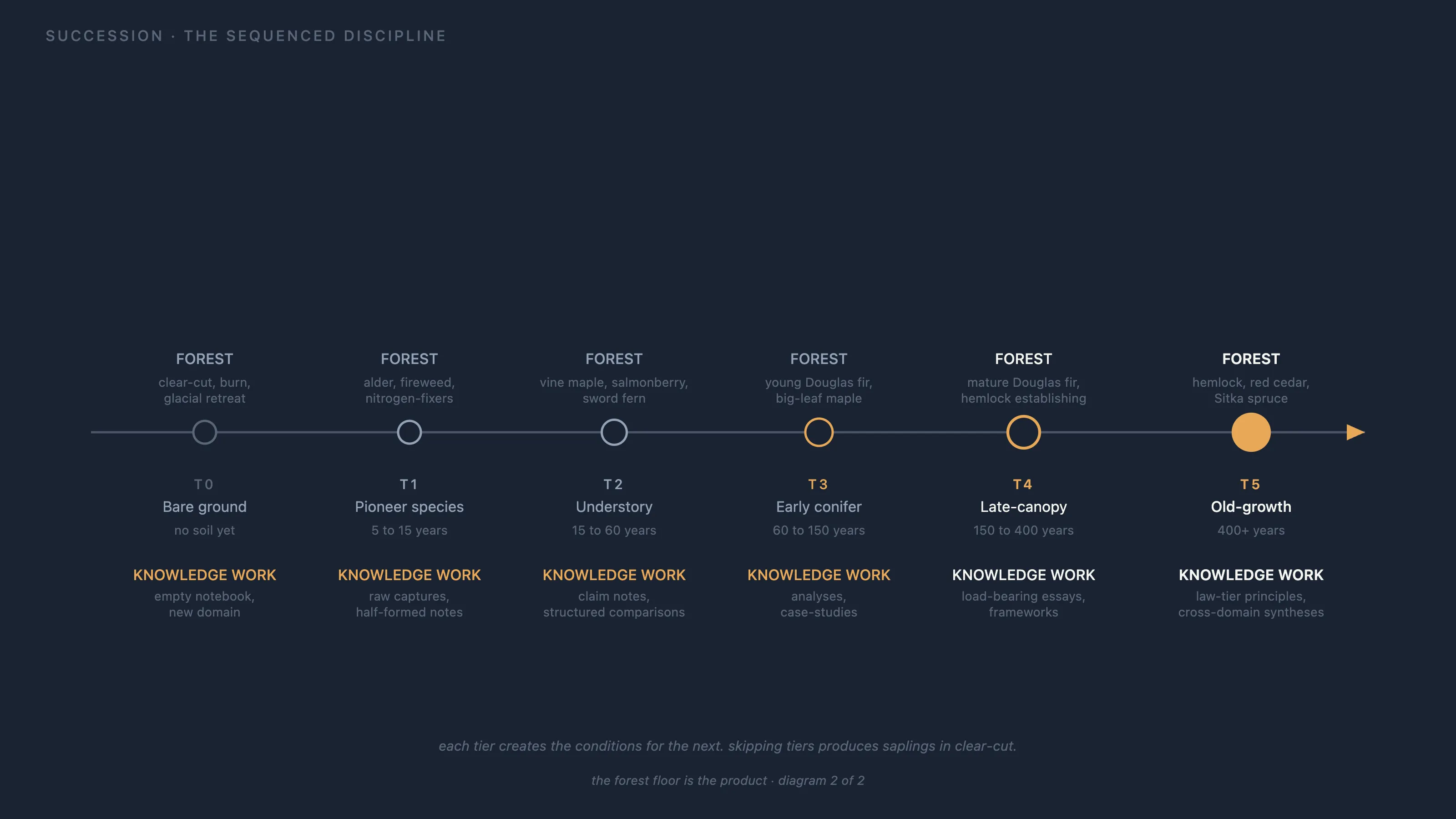
Pioneers arrive first. In the Pacific Northwest these are species like red alder, fireweed, and the hardy shrubs that move into any disturbed lot. They are short-lived and fast-growing, and they do one thing the bare soil cannot yet do for itself. Alder fixes nitrogen, which means it pulls nitrogen out of the air and locks it into the soil so other plants can finally use it later.5 Fireweed holds the loose ash and char that fires leave behind. Together the pioneers prepare ground that nothing else could grow on.
Then come the early conifers. Douglas fir is the classic one. It takes hold in the soil the pioneers built, in the light the pioneers no longer monopolise. The mid-canopy thickens. The soil deepens. The water cycle stabilises. The forest starts to look like a forest.
Only after another century of that, sometimes longer, do the climax species begin their long work. Western hemlock. Western red cedar. Sitka spruce. These are the trees that can grow in deep shade, on deep soil, and that take centuries to reach their final form. They could not have started earlier. The conditions to support them did not exist.
You do not wait for old growth. You sequence the conditions that make it inevitable.
The 2026 mistake is to treat durability as a waiting game. As something that happens if you stick around long enough. As patience. It is none of those things. It is a sequenced discipline.
People who build durable work, in any field, run succession on purpose. They start with the equivalent of pioneer species in the soil. Raw notes. Half-formed observations. Captures of things they do not yet understand. None of it looks important on its own. They tend that layer until it gets dense enough that something more structured can grow in it. Then come the middle-tier pieces: working analyses, side-by-side comparisons, the first attempts to make sense of what the captures are saying. Only then can the late-canopy work germinate at all: the long-form synthesis, the load-bearing essay, the framework other people start citing.
You see the same pattern in research, in product, in writing, in companies. The famous output is the late-canopy tree. The two layers underneath it, mostly invisible, are what made it possible at all. Skip them and you get a sapling planted in clear-cut. It dies. Or worse, it survives long enough to look promising, then dies in the first dry summer.
The disciplined version asks a different question about everything you produce. Not “is this important enough to keep?” Pioneers do not look important. Nitrogen-fixers do not look important. The real question is “what is the next layer that this would make possible?” If the answer is nothing, you have grown a piece of fireweed. Fine. Note it and move on. If the answer is something, you have laid down a millimetre of soil, and the next thing planted in it will go further.
This is a hard reframe to swallow because almost no incentive structure in 2026 rewards pioneer-tier work. There are no metrics for soil-building. There is no leaderboard for the work nobody can see yet. The reward structure prizes the late-canopy tree, the visible output, the thing that can be screenshotted. Anyone who wants old-growth work has to pay for the underlayers themselves, with their own time, against the gravitational pull of a culture that only ever looks at the canopy.
The pay-off, when it comes, is disproportionate. A late-canopy synthesis grown out of a thick understory is not the same animal as a sapling planted in bare ground. The first is rooted in a system. The second is decoration.
Disturbance Is How New Growth Happens
A forest that never gets disturbed slowly chokes itself.
This is one of the most counterintuitive results in 20th-century forest ecology. The intuitive model says: protect the forest, suppress the fires, keep the loggers out, and you will have a healthy ecosystem. That was the dominant US Forest Service policy for most of the 20th century. The result was forests that were denser, more uniform, more disease-prone, and far more vulnerable to catastrophic fire than the ones the policy was meant to protect.6
What was missing was disturbance. Specifically, the small, frequent, gap-creating disturbance that opens a hole in the canopy and lets new species establish. A 40-metre tree falls in a storm. Light hits the forest floor for the first time in two centuries. Seeds that have been sitting dormant in the soil germinate. New species establish. The gap closes over thirty years. Net result: the forest stays younger in patches, more diverse, more resilient.
Without disturbance, the canopy holds. The same handful of dominant species keep their position. The understory, the layer of smaller plants growing under the canopy, thins out. New growth has nowhere to go. The forest looks fine for fifty years and then collapses all at once.
AI is not the storm. AI is the canopy gap. Different question, different answer.
The default 2026 reading of AI is the storm reading. The canopy is collapsing, the dominant species are about to be displaced, panic is the right response, and the only move left is to grab a chainsaw and join the felling. That reading is wrong in a precise way. It treats the disturbance as terminal rather than generative.
The forest reading is different. AI is a canopy gap. A patch of light has opened that was not there before. Species that were dormant in the seed bank for decades, because there was no light for them, can now germinate. Species that already dominated the canopy are not necessarily displaced. They no longer monopolise the light. Whether the gap closes back into the same forest or grows into a different one depends on which seeds were already in the soil.
This changes the question you ask about your own work. Not “how do I survive AI?” Try this instead: which seeds were sitting in my seed bank that this canopy gap finally lets me plant? Some of these will be projects you would not have started without AI. Some will be species of work you abandoned years ago because the canopy was too closed for them to survive. Some will be whole categories of practice that stayed dormant because no one had the substrate to grow them in.
You can do this audit on a single sheet of paper. Three projects you would not have started without AI. Three projects you should have stopped because they were filling space that could now be a gap. Three things in your seed bank that have been waiting for light. The output of this exercise is rarely what you expect. Most people find that the projects they would have stopped are obvious in retrospect and were obvious before AI arrived. They were being kept alive by inertia. The disturbance reveals what was already not working.
The mature operator does not chase disturbance. They read it. They wait long enough to see which gap opened, which species the disturbance favoured, and which dormant seeds in their own seed bank are now viable. Then they plant. The species that fill a canopy gap fastest are not always the species still standing in fifty years. The 2026 winners will be the people who can tell the difference and plant for the second forest, not the first.
The Forest That Knows It Is a Forest
The knowledge system underneath this essay is itself an old-growth forest, by my reckoning. It is built around five claims that show up, independently, in field after field. They were not invented for this article. They were derived, over thousands of analyses, from patterns that kept appearing across AI research, neuroscience, financial markets, biology, and history. I have written about them before. They are the backbone of every other piece in this newsletter.
Read them as a forester would, and they stop sounding abstract.
Law I says the bottleneck always migrates. In the forest this is succession. Whatever is limiting the system moves up the stack as each layer matures. First the soil is the limit. Then it is light at the floor. Then it is competition for canopy space. Then it is the carrying capacity of the fungal network. Whatever was limiting last decade is not what is limiting now. The forester still fertilising soil that is no longer the bottleneck is wasting effort, in exactly the same way the operator still optimising last year’s layer is wasting theirs.
Law II says difficulty is load-bearing. In the forest this is the soil profile. The slow accretion, one millimetre per century, is what makes a 400-year-old tree possible. There is no shortcut soil. There is no fertiliser that produces old-growth substrate. The difficulty is doing a job, and removing it does not accelerate the forest. It produces a different forest, one that gets cleared in a generation.
Law III says architecture outlives content. In the forest this is the mycorrhizal network. Individual trees come and go over centuries. The fungal network beneath them persists across generations of trees.7 The trees are content. The network is architecture. Forests that lose their fungal substrate, through clear-cutting or soil disturbance, do not grow back the same way even when you replant the trees. The architecture is gone, and the content has nowhere to root.
Law IV says knowledge is constrained by instruments, not theory. In the forest, your instrument was your eye, and your eye could only see the canopy. For most of human history, foresters knew the trees and not the soil, because the trees were the only thing the available instrument could resolve. Soil cores, isotope tracers, modern mycology: those gave us the substrate. The substrate was always there. The instrument was new. Every field has a moment like that. AI is one of them now, and the operators building the right instruments will see what the canopy-only operators cannot.
Law V says capability without correct targeting makes things worse. In the forest, this is canopy gap targeting. A storm opens a gap. If you respond by planting more of the species that already dominated the canopy, you have added capability aimed at where the old forest was, not where the new gap is. That is most 2026 AI strategy in one sentence: capability poured into the layer of work that just got commoditised. The targeting is wrong. More capability does not fix wrong targeting. It accelerates the misalignment.
The five laws are not five laws. They are one forest, viewed from five angles.
The reason this matters is that almost every operator in 2026 is reading their situation one law at a time. They are optimising the bottleneck where it used to be. They are removing friction that was doing structural work. They are investing in tools and ignoring the architecture underneath. They are theorising harder instead of building better instruments. They are adding capability aimed at the wrong target. Any one of those damages the system. All five together give you a forest that looks productive for a year and is gone in three.
The five-law reading is one diagnostic, not five. Read your situation as a forest, then ask. Where has the bottleneck moved to? Is the friction you want to remove doing structural work? Is your effort going into the architecture underneath, or the canopy on top? Do you have the instrument to see the substrate? Is your capability aimed at the gap that just opened, or the one that closed years ago?
These are not slogans. They are a single diagnostic, applied to one system at a time, in writing.
The One-Week Test
Pick one project you shipped in the last 90 days. Not your favourite. One that was real. Open the file. Read it again.
Then sit with three questions, one paragraph of writing each.
What is the substrate this output is sitting on? Not the tools, not the framework, not the model. The accumulated thing: the judgement, the taste, the relationships, the context that made this specific output possible and would not have been there a year ago. If the honest answer is “I do not know,” good. That is an honest answer and it is telling you something.
What is the canopy gap that created the conditions for this project to exist now? What disturbance opened the light it grew into? If the project would have been impossible two years ago, name what changed. If the project would have been possible two years ago and you only got to it now, name what was holding the canopy closed.
If the model that helped you write this output were obsolete tomorrow, what would survive? The substrate or the canopy? The output or the architecture underneath it? The visible thing or the slow accretion that produced it?
Most operators cannot answer all three the first time they run this test. That is not failure. That is the diagnostic. The point is not the answers. It is noticing which question comes hard. The forced one is where the canopy is hiding the soil. That is the layer you cannot yet see, which usually means it is also the layer you are not yet tending.
The good news is that the underlayers are slow to build and slow to lose. A year of deliberate substrate work is worth more than a decade of reactive canopy chasing. The forest is patient that way. Once the soil is built, it holds.
The canopy is what gets the light. The forest is what is still standing in 400 years.
If you ran the test this week, I want to know which of the three questions was the one you could not answer. That will tell me which layer of the forest most readers cannot yet see, which will tell me which piece to write next. Comments are open below.
The longer self-assessment version of this test, called The Forest Floor Audit, takes about thirty minutes and walks through the five layers in detail. Free, linked at the foot of this post.
The Carmanah Giant grows in Carmanah Walbran Provincial Park on the west coast of Vancouver Island, in Ditidaht territory. It is widely cited as the tallest tree in Canada at approximately 96 metres (315 ft). Published age estimates vary considerably, ranging from under 400 years to around 700 years, with no single authoritative dendrochronology on record. See Ancient Forest Alliance, “Conservationists locate and climb the largest Sitka spruce tree in BC’s famed Carmanah Valley” (2024), https://ancientforestalliance.org/climbing-carmanah-valley-largest-sitka-spruce/, and BC Geographical Names, https://apps.gov.bc.ca/pub/bcgnws/names/41299.html
Mycorrhizal hyphae are typically 2 to 10 micrometres in diameter, around an order of magnitude thinner than a human hair, which averages 50 to 100 micrometres. The density of fungal mycelium in mature temperate forest soils has been measured at hundreds of metres of hyphae per gram of soil. See Read, D.J. & Perez-Moreno, J., “Mycorrhizas and nutrient cycling in ecosystems — a journey towards relevance?” New Phytologist 157 (2003), https://doi.org/10.1046/j.1469-8137.2003.00704.x
Simard, S.W., Perry, D.A., Jones, M.D., Myrold, D.D., Durall, D.M. & Molina, R., “Net transfer of carbon between ectomycorrhizal tree species in the field,” Nature 388, 579 to 582 (1997), https://doi.org/10.1038/41557. The original demonstration of bidirectional carbon transfer between birch and Douglas fir through shared mycorrhizal networks. Simard’s later work, including the 2016 TED talk How Trees Talk to Each Other, brought the wood-wide web into wider awareness. The strong forms of the wood-wide-web hypothesis have been challenged in recent years, notably Karst, J., Jones, M.D. & Hoeksema, J.D., “Positive citation bias and overinterpreted results lead to misinformation on common mycorrhizal networks in forests,” Nature Ecology & Evolution 7 (2023), https://doi.org/10.1038/s41559-023-01986-1. The narrower claim used in this essay, that adjacent trees can exchange resources through shared fungal connections under measured conditions, remains well-evidenced.
Estimates of the proportion of land plants forming mycorrhizal associations range from 80 to 92 percent depending on methodology and habitat. See Wahab, A. et al., “Role of Arbuscular Mycorrhizal Fungi in Regulating Growth, Enhancing Productivity, and Potentially Influencing Ecosystems Under Abiotic and Biotic Stresses,” Plants 12 (2023), https://doi.org/10.3390/plants12173102. For the philosophical reframe of forests and humans as networked rather than individual, see Webb, C., We Have Never Been Individuals, Behavioral Scientist, https://behavioralscientist.org/we-have-never-been-individuals/, and Webb, C., The Arrogant Ape: The Myth of Human Exceptionalism and Why It Matters (2025).
Red alder (Alnus rubra) hosts nitrogen-fixing Frankia bacteria in root nodules and can fix 100 to 300 kg of nitrogen per hectare per year in Pacific Northwest forests, materially altering soil chemistry within a single rotation. See Binkley, D., Sollins, P., Bell, R., Sachs, D. & Myrold, D., “Biogeochemistry of adjacent conifer and alder-conifer stands,” Ecology 73 (1992), https://doi.org/10.2307/1941452
The shift away from total fire suppression in US Forest Service policy followed the 1995 Federal Wildland Fire Management Policy review, which formally recognised that decades of suppression had produced denser, more vulnerable forests. See Stephens, S.L. & Ruth, L.W., “Federal forest-fire policy in the United States,” Ecological Applications 15 (2005), https://doi.org/10.1890/04-0545
Estimates of the proportion of land plants forming mycorrhizal associations range from 80 to 92 percent depending on methodology and habitat. See Wahab, A. et al., “Role of Arbuscular Mycorrhizal Fungi in Regulating Growth, Enhancing Productivity, and Potentially Influencing Ecosystems Under Abiotic and Biotic Stresses,” Plants 12 (2023), https://doi.org/10.3390/plants12173102. For the philosophical reframe of forests and humans as networked rather than individual, see Webb, C., We Have Never Been Individuals, Behavioral Scientist, https://behavioralscientist.org/we-have-never-been-individuals/, and Webb, C., The Arrogant Ape: The Myth of Human Exceptionalism and Why It Matters (2025).
The Forest Floor Audit
The longer self-assessment version of the one-week test
Forest Floor Audit
207KB ∙ PDF file