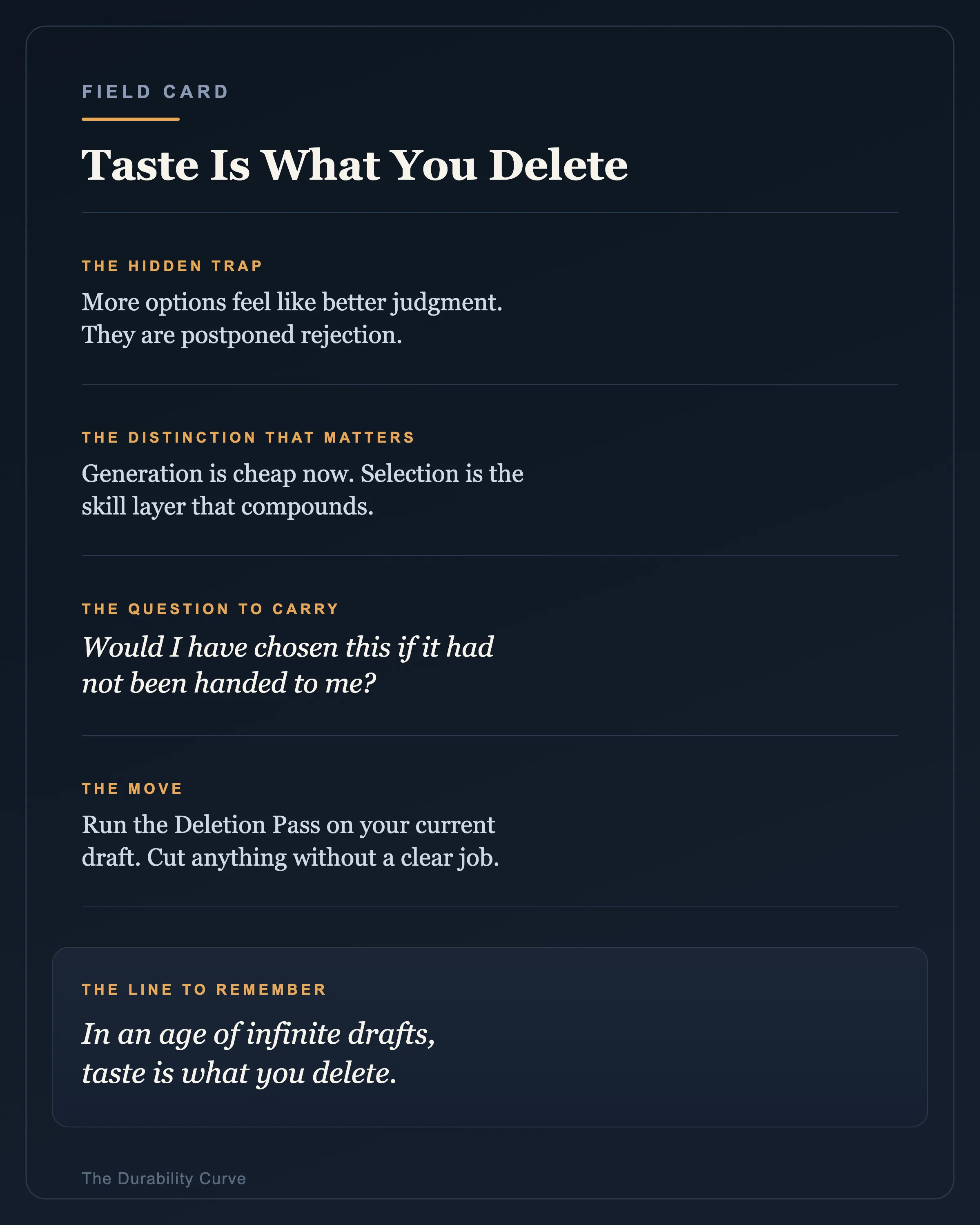
Taste Is What You Delete
Generation got cheap. The scarce skill is knowing what to cut.
Generation is not judgment.
Generation got cheap. The scarce skill is knowing what to cut.
Ten versions in ten seconds
The old problem was the blank page.
The new problem is ten versions in ten seconds.
Ten headlines. Ten logos. Ten app screens. Ten strategies. Ten rewrites of the same paragraph, all fluent, all plausible, all close enough to make the next move harder.
At first this feels like power.
Then it starts to feel like fog.
You ask for more options because the current options are not quite right. The model gives you more. Some are cleaner. Some are louder. Some are safer. Some are more polished. None of them obviously solves the problem.
So you ask again.
Now you have thirty.
This is the quiet inversion AI creates in creative work.
The scarce part is no longer producing a candidate. The scarce part is deciding which candidates should die, and being able to explain why.
Taste used to look like an additive talent. The person with taste seemed to have better ideas, better words, better colours, better instincts.
That is only half true.
Taste is mostly deletion.
It is the ability to look at ten plausible things and know which nine are weakening the work.
That sounds negative until you do it. Deletion is not pessimism. It is how the shape appears.
More options can make you worse
There is a comforting story about AI creativity.
More drafts means more choice. More choice means better final work. Better final work means better taste.
Sometimes that is true.
If you are exploring a territory you barely understand, more options can open doors you would not have found alone. A model can throw strange combinations at you, break your first frame, suggest directions that feel embarrassing until one of them reveals a useful path.
That is real.
But it is the divergent phase.
The dangerous phase comes after.
At some point the work has to converge. The paragraph has to say one thing. The product has to choose one promise. The landing page has to make one person feel seen. The strategy has to commit to one bet. The image has to carry one mood.
AI helps you postpone that pain.
It lets you stay in option-space long after the real work has become selection. You can keep generating instead of deciding. You can keep polishing instead of cutting. You can keep asking for alternatives instead of admitting that the problem is not a shortage of drafts.
It is a shortage of rejection.
Taste is not a vibe
People talk about taste as if it is a private glow.
Someone has taste. Someone does not. A founder has product taste. A designer has visual taste. A writer has sentence taste. A curator has cultural taste. The word floats above the work, admired but rarely inspected.
That framing is convenient because it makes taste sound untrainable.
I think it is more useful to treat taste as a working capacity:
Taste is the trained ability to reject what almost works.
Not what obviously fails. That part is easy.
Anyone can delete the broken paragraph, the unreadable mockup, the nonsense strategy, the image with six fingers, the feature nobody asked for.
A bad option announces itself. A plausible option negotiates.
Taste starts where the thing is acceptable.
The sentence is clear, but too expected.
The design is clean, but forgettable.
The feature is useful, but off-strategy.
The argument is true, but not alive.
The idea is clever, but it does not change the reader’s next move.
This is why AI makes taste more important. It is very good at producing almost-working things.
Almost-working things are hard to kill.
The phrase did the thinking
George Orwell’s Politics and the English Language is still useful here because it treats bad prose as a failure of attention, not just style. His target was political language, but the craft mechanism is broader: stale phrases, inflated diction, passive padding, and ready-made expressions let the writer stop looking directly at what they mean.1
That is the part that matters now.
The danger of AI prose is not only that it sounds like AI. The deeper danger is that it gives you language before you have earned the thought.
The phrase arrives finished.
“Unlocking potential.”
“Navigating complexity.”
“A robust framework.”
“At the intersection of X and Y.”
“Not just a tool, but a partner.”
None of these phrases is evil in isolation. The problem is that they are available before the writer has made a choice.
They are prefabricated thinking.
When you accept them, you inherit the shape of a thought without doing the work of locating the thought itself. You can feel the page becoming smoother while the claim becomes less yours.
This is why deletion is not cosmetic.
Deleting a phrase can reveal that there was no thought underneath it.
That is useful.
It tells you where the work is.
The empty place is not a failure. It is the honest outline of the next sentence.
Good taste is not perfect agreement
The obvious objection is that taste is subjective.
People disagree. Experts get it wrong. Styles change. What feels sharp to one reader feels cold to another. What feels beautiful in one culture can feel empty in another.
All true.
But “not perfectly objective” is not the same as “random.”
Paul Graham makes a useful argument here. If there were no such thing as good taste, then there would be no such thing as good art, and therefore no way for artists to be good at their jobs. That conclusion is absurd. People can be better or worse at painting, writing, acting, composing, designing, and judging. Taste is messy, but not imaginary.2
The practical point is simpler than the philosophy.
Taste is not perfect consensus.
Taste is better discrimination under pressure.
It is the ability to notice the difference between:
Clear and obvious.
Simple and thin.
Polished and true.
Interesting and useful.
Novel and merely weird.
Confident and overfitted.
Human and human-sounding.
That discrimination improves through exposure, practice, comparison, and refusal. You see more work. You make more work. You compare the almost-good against the actually-good. You learn which signals are real and which are social noise.
AI can increase exposure.
It cannot do the refusal for you.
The slop problem is a selection problem
AI-assisted writing often repeats the same moves because models learn from patterns that occurred often enough to become likely.
The model learns the common move.
The confident opener.
The balanced contrast.
The soft caveat.
The tidy closer.
The problem is not that every common move is wrong. Common moves become common because they often work somewhere.
The problem is that common moves are cheap.
They arrive too easily.
Slop is not a list of banned words. It is what happens when familiar language arrives faster than judgment.
A human with taste does not merely ask, “Is this sentence grammatical?” or “Does this paragraph sound professional?” That bar is too low now. The better question is:
Would I have chosen this if it had not been handed to me?
Most AI-assisted work fails there.
Not because the model is useless. Because the human has not taken responsibility for the final selection.
You can see it in writing, but the same pattern shows up everywhere.
The product team ships the feature that sounds good in a roadmap but does not sharpen the product.
The founder keeps the positioning line that flatters the company but does not make the buyer move.
The designer keeps the visual flourish that signals effort but weakens the hierarchy.
The analyst keeps the chart that is technically accurate but answers the wrong question.
The creator keeps the section that proves they did research but slows the piece down.
These are not generation failures.
They are deletion failures.
The Deletion Pass
The useful question is not “how do I make more?”
It is “what has earned the right to remain?”
Run this on any AI-assisted draft, design, memo, article, product idea, or strategy.
First, make the option set. Let the model help. Generate widely. Explore. Ask for alternatives. Get the obvious versions out of your system.
Then stop generating. This is the part people skip.
Now run the Deletion Pass.
Ask five questions.
What is this piece actually trying to do?
Which part is only here because it sounds good?
Which part could be removed without changing the outcome?
Which part feels polished but hides a weak decision?
If I had to keep only one line, feature, image, or claim, what would survive?
That last question is the taste test.
Not because everything else is worthless. Because the strongest element reveals the job of the whole thing.
If you cannot name the survivor, the work has not converged yet.
Do not just delete silently. Keep a short cut list:
I cut this because __________.
That one sentence turns deletion into learning. Over time, the cut list becomes a map of your taste: the phrases you no longer trust, the features you keep overbuilding, the kinds of cleverness that make your work worse.
The test is simple enough to draw:
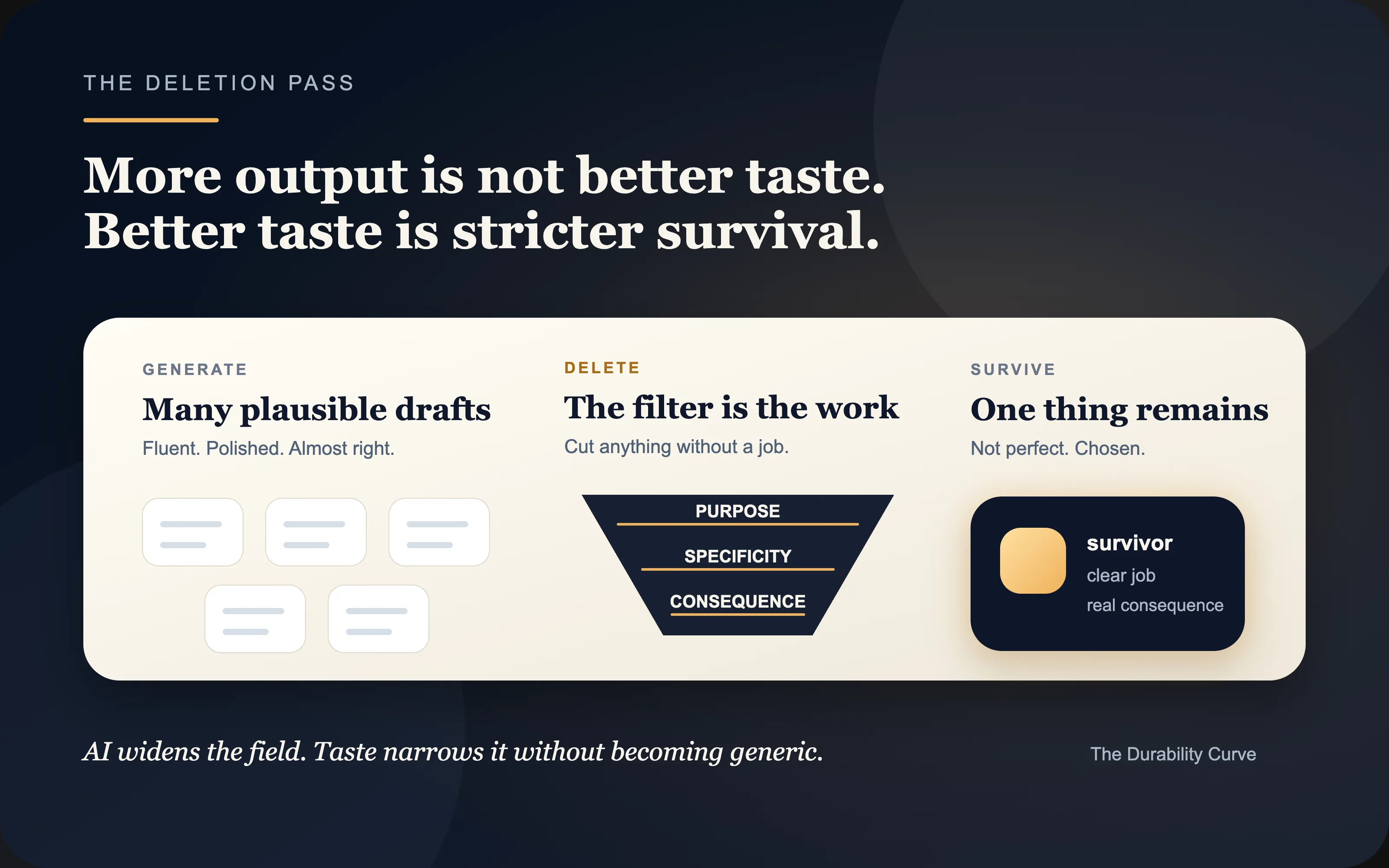
AI widens the field. Taste narrows it without becoming generic.
The hard reps are the point
There is a subtle trap in using AI as a creative partner.
It can remove the reps that build taste.
The bad draft matters because you learn why it is bad.
The awkward sentence matters because you feel where the rhythm breaks.
The failed design matters because you learn what your eye was pretending not to see.
The rejected feature matters because it teaches you the product’s actual spine.
The wrong strategy matters because it exposes the hidden assumption.
If AI skips you over all of that, you may get a better first output and a weaker internal judge.
That is not a reason to avoid AI. It is a reason to use it in a way that keeps the hard reps alive.
Do not only ask the model to generate.
Ask it what should be cut.
Ask it which option is most generic.
Ask it which paragraph is pretending to be useful.
Ask it which section exists to prove effort rather than serve the reader.
Then disagree with it.
Make the final deletion yourself.
That is where the skill compounds.
The person who can delete
The next advantage in creative work will not belong to the person who can make the most drafts.
Everyone will have drafts.
It will not belong to the person with the longest prompt.
Prompts will spread.
It will not belong to the person who can produce the most polished surface.
Polish is getting cheaper.
It will belong to the person who can stand in front of abundance and remove what does not belong.
The person who can kill the clever line.
The person who can cut the feature that investors liked.
The person who can delete the slide that makes the deck feel smarter but the decision less clear.
The person who can look at twenty AI-generated options and say:
No.
No.
No.
This one.
And then make that one better.
In an age of infinite drafts, taste is not what you add.
Taste is what you delete.
What is one thing in your current work that probably sounds good but has not earned the right to stay?
Footnotes
-
George Orwell, Politics and the English Language, first published in Horizon (April 1946), hosted by The Orwell Foundation, https://www.orwellfoundation.com/the-orwell-foundation/orwell/essays-and-other-works/politics-and-the-english-language/. Orwell’s rules and examples are used here as a craft analogy for deletion and conscious word choice. ↩
-
Paul Graham, Is There Such a Thing as Good Taste? (November 2021), http://www.paulgraham.com/goodtaste.html. Graham argues that taste is neither perfect consensus nor pure randomness; the article uses that limited point, not a claim that aesthetic judgment is fully objective. ↩