Right Company, Wrong Vector
A pick is a number. A position is a vector. The post-mortem language we have only knows how to blame the company.
In November 2011, Berkshire Hathaway bought sixty-four million shares of IBM at an average price of around one hundred and seventy dollars. The position was worth roughly $10.7 billion at cost. It was a 5.5 percent stake in the company and one of the largest single positions Berkshire had ever opened in a publicly traded name. 1
The thesis Warren Buffett put on the inside cover of that position was specific. IBM was no longer a hardware company. It was a services-led moat with deeply embedded enterprise customers who would not switch lightly. The thing he was buying was the durability of that moat against everyone trying to displace it. 2
Six years later he sold most of it, in stages, at prices below where he had bought. By the spring of 2018 the position was gone. Over the same window IBM stock was down roughly eighteen percent. The S&P 500 was up one hundred and sixteen percent. Berkshire’s other technology bet, the AAPL position Buffett had begun in 2016, had already grown larger than IBM had ever been on Berkshire’s book.
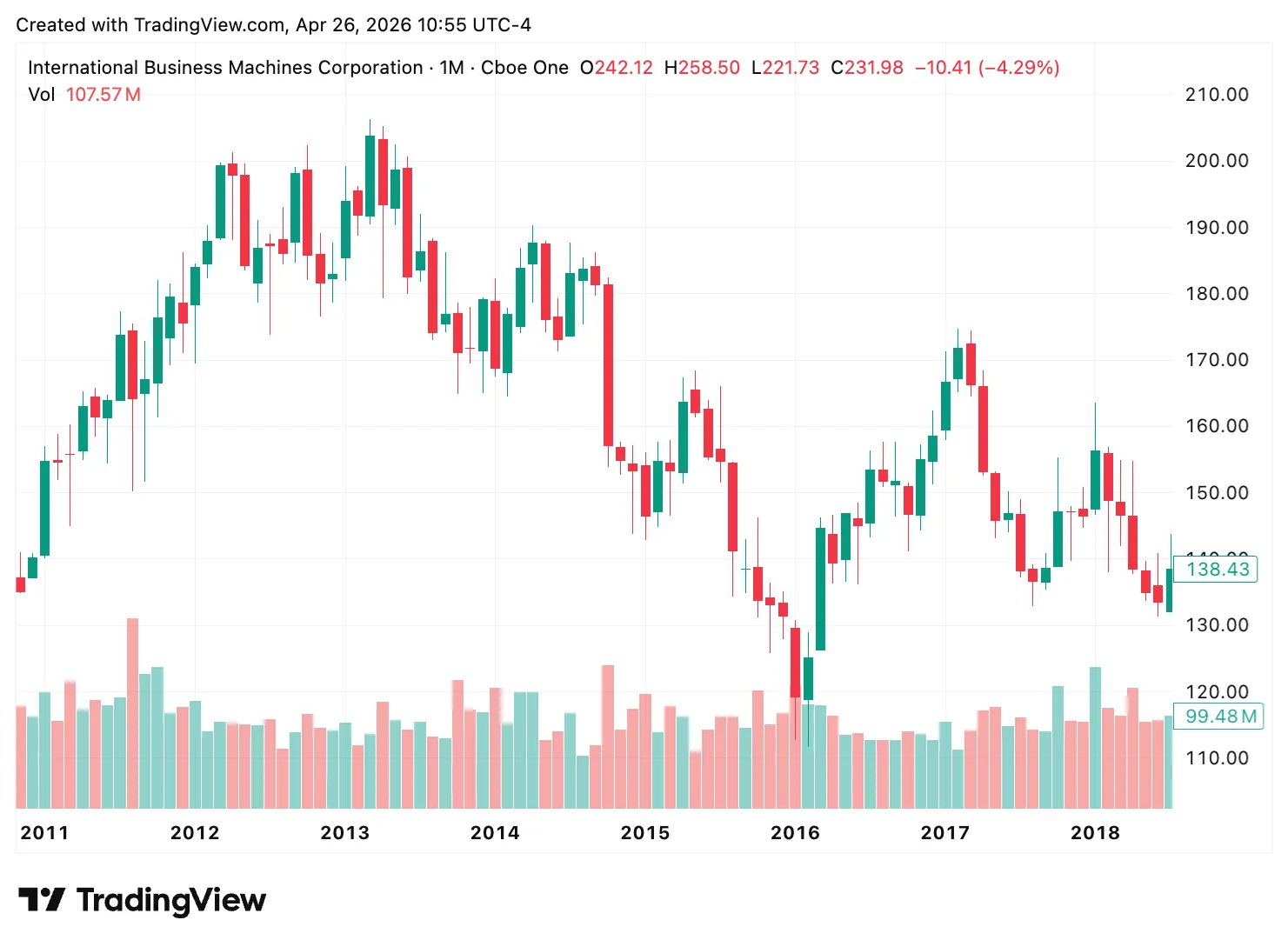
IBM - 2011 - 2018
In May 2017 he told CNBC, “I don’t value IBM the same way that I did six years ago when I started buying. I’ve revalued it somewhat downward.” 3 Nine months after the exit was complete, he was more direct. “I was wrong, or at least I felt like I was wrong on IBM when I sold it and I was wrong when I bought it.” 4
That second sentence is the one to read carefully.
It does the only thing the vocabulary lets it do. It blames the thesis. The whole story collapses into a single axis. Was he right about the company, or was he wrong about the company. He worked out he was wrong. He said so out loud, in public, with his own name on it, which is more than almost anyone in the industry will ever do.
And the most articulate post-mortem voice in modern finance still got compressed into one word.
Wrong.
This essay is about what is missing from that word.
A Pick Is a Magnitude. A Position Is a Vector.
In physics class, a magnitude is a number. A vector is a number with a direction attached. Forty miles per hour is a magnitude. Forty miles per hour going north is a vector. The two carry different information. A magnitude tells you how much. A vector tells you how much, and where it is pointed. The investing industry has one word for both, and it is the wrong word.
If you have ever held a name through a triple and not felt the triple in your book, you have lived this. The magnitude was right. The vector was wrong.
A position is a vector with at least seven slots. Size is one of them. The thesis sentence is another. The other five are the ones the post-mortem cannot name out loud: what would have to be true for the thesis to be wrong, how long the thesis is allowed to take, what other names in the book this position is correlated to, what the position pays out if the thesis only half-lands, and how the position would be exited if the falsifier triggered.
Each of those is a separate decision. Each can move while the ticker stays the same. None of them are in the magnitude. The whole apparatus of the industry, the position percentage on a tearsheet, the weight in a 13F filing, the line in a quarterly letter, is built to compress all seven slots into the one slot the file format can hold.
A pick is a magnitude. A position is a vector. The industry’s word for both is the same word, and the word that wins is the smaller one.
The category error sits here. The investor hears “what is your largest position” and answers with a name and a percentage. The right answer, the one that survives a bad year, is a profile. The percentage is one number in that profile. It is not the profile.
Two Investors. One Company. Two Different Positions.
Run the thought experiment with two investors over Buffett’s window.
Both wrote the same thesis on the inside cover in November 2011. IBM is no longer a hardware company. It is a services-led moat with deeply embedded enterprise customers who will not switch easily. The same paragraph. The same name. The same year.
The first investor sized the position to roughly five percent of the equity book on conviction in the moat. The exit rule was “if I change my mind.” The holding period was “long term.” The falsifier was nowhere on paper. The dependency on the cloud transition being slow rather than fast was implicit, not stated. The opportunity cost against the next-best technology bet of the decade was not tested until that bet had already done the heavy work for someone else.
The second investor sized the same thesis at one percent. They wrote a falsifier in the position memo: if IBM’s services revenue declines for two consecutive quarters with management citing competitive losses to cloud-native vendors, the moat thesis is invalidated for this regime, and the position closes within the next reporting cycle. The holding period was a rolling four-quarter window, not “long term.” Re-evaluation was on the calendar at every print. The dependency on the cloud transition being slow was named explicitly, so any acceleration in cloud adoption would tighten the falsifier rather than leave it dormant.
By 2014, when IBM’s services revenue first showed real cracks with explicit cloud-competitive language from management on the call, the second investor’s falsifier triggered. They closed the position into the next reporting cycle at a small loss against entry and redeployed. The first investor read the same earnings, watched the chart hold, and stayed.
Same thesis. Same company. Same paragraph on the inside cover. Two completely different positions, three years apart in their first invalidation event, with two completely different outcomes downstream.
Two investors with the same thesis on the same company can hold completely different positions, and only one of them can be reverse-engineered from the post-mortem.
When the first investor wrote up the failure, the only sentence available was “I was wrong about IBM.” It is not actually a true sentence about the thesis. The thesis was approximately right at the level of granularity at which it was written. IBM did remain a services-led business. Most of its enterprise customers did not switch lightly. The moat existed. It just degraded faster than the size and the holding period and the missing falsifier had quietly assumed it would.
The vocabulary made it look like a thesis error. It was a vector error, in the durability slot, the falsifier slot, the holding-period slot, and the opportunity-cost slot. Four wrong directions on a vector that was being held as if it were a magnitude.
The Substrate Speaks Before the Headline
The second investor noticed something the first one did not.
A thesis is a claim about a substrate. IBM has a services moat is not the substrate. It is a sentence about the substrate. The substrate itself is the network of switching costs, the salesforce relationships, the integration debt customers had built on IBM’s stack, the technical depth of the services organisation, the rate at which competitors could credibly displace any of those things. The thesis sentence holds up only as long as the substrate underneath it does.
Substrates erode slowly. They erode in the kind of small, public, observable details that do not move the price chart for several quarters. AWS launched in 2006. By 2013 it was at scale. By 2014 enterprise cloud adoption was visibly accelerating in exactly the kind of Fortune 500 customer accounts IBM’s services moat was supposed to protect. By 2015 IBM’s own earnings calls were naming cloud competitive pressure in the services segment.
The price chart did not reflect any of that until 2016, and even then only partially. The headline followed the substrate by about three quarters.
If you have ever read a 10-Q where a segment that used to anchor the thesis is suddenly being described in defensive language, and decided to wait one more print to confirm what you already knew, you have felt this. The substrate told you. The headline took another nine months to follow.
The substrate erodes three quarters before the headline does. The score is the only instrument that can read the gap.
A long-only allocator’s highest-leverage early warning is not the price chart. It is a substrate score, written down at a fixed cadence, against a stable framework. Score the durability of the moat. Score what the position pays out if the thesis only half-lands. Score the dependence on couplings the world is moving against. Score the optionality the position carries if the thesis is wrong. Re-score every six months. Any axis that has dropped twice in a row is no longer the position that was opened. Any axis that drops by a full point earns one paragraph in the log: what changed, and what would have to be true for the score to recover.
Earnings dates make this almost free. They are not news. They are pre-scheduled observability windows. Same date every quarter, same disclosures, same metrics, an instrument with a known sampling time. The investor who runs the same protocol at every window has a research process: read the thesis, read the falsifier, write three listen-fors before the call, log the result against each listen-for after the call. The investor who reacts to whichever earnings happened to be loudest has a feed.
A position held on the strength of the thesis sentence alone, without any substrate score behind it, is sized on conviction without an invalidation rule. That is what every post-mortem ending in the single word wrong has in common.
Every Commitment Has a Heading
The lens is not about investing.
A hire is a position. The thesis is the candidate’s competence. The vector is the role they are hired into, the team they are embedded with, the manager they report to, the falsifier (what would constitute a bad-fit signal in ninety days), the time-box (how long the trial period runs in practice), the couplings (whose other work depends on this hire), and the exit (what graceful off-boarding looks like). The same person can be a brilliant hire in one vector and an expensive one in another. The thesis on the candidate is the same. The vector decides whether the year ends in a promotion or a severance package. Most failed hires get post-mortemed as bad hiring decisions. Some are. Many of them are wrong-vector decisions on right hires, and the language only knows how to blame the candidate.
A research bet is a position. The thesis is the hypothesis. The vector is the experimental design, the cohort size, the time-budget, the falsifier, the dependencies on parallel experiments, the exit rule. Two labs with the same hypothesis run different experiments, and one paper lands and the other does not replicate. The hypothesis was the same. The vector was different.
A founder’s first market is a position. The thesis is the product. The vector is the timing, the geography, the segment, the pricing, the go-to-market motion. Same product, two markets, two outcomes. The founder who failed in 2018 with a webhooks tool and succeeded in 2024 with the same webhooks tool was right both times on the product. The vector was different.
Every committed action has a heading. Most of us only ever name the destination.
The reason the lens travels is that the failure mode travels with it. Anywhere a committed action is named by its scalar headline (a hire by the candidate’s name, a research bet by the hypothesis, a market entry by the product), the language collapses the vector into the magnitude and the post-mortem inherits the collapse. “I was wrong about him.” “I was wrong about the hypothesis.” “I was wrong about the market.” The post-mortems sound the same because the vocabulary makes them sound the same. They are usually about different axes, on different vectors, of different kinds of commitment, and the language has no way to say so.
Six Lines, Five Numbers, Ten Minutes
Pick the largest position in the book. It does not have to be a position in the markets. It can be the most expensive person on the team, the most time-consuming research line, the largest standing commitment of attention to a single bet of any kind.
Write the company, or the person, or the project, on one line.
Write the thesis sentence on the next.
Write the substrate sentence underneath it. The one sentence that names what has to be true about the substrate beneath the thesis for the thesis to play out. Not the thesis restated. The thing the thesis silently depends on.
Write the falsifier on the next line, with a number or a date attached. The one sentence that names what would have to be true for the thesis to be wrong, in a form specific enough to trigger when the time comes.
Score the five axes. Durability, asymmetry, replicability, couplings, optionality. One to ten on each.
Write down what would make each axis drop a point.
Six lines. Five numbers. About ten minutes for a commitment the book is genuinely committed to.
The substrate sentence comes hardest. The falsifier comes second. The five axes come quickly because the test is structured. The substrate sentence and the falsifier ask for prose the position memo never demanded, and that is the diagnostic. If the substrate sentence is hard to write, the position is being held on thesis alone, and the substrate is doing all the work and getting none of the credit. If the falsifier is hard to write, the position is sized off conviction without invalidation, which is the structural shape of every position that is one earnings call away from a permanent loss the post-mortem will struggle to explain.
The strongest counter to running this exercise at all is that elaborate position-scoring is activity bias dressed up as discipline, and that for most allocators most of the time the right move is to own a broad-market index fund and stop touching it. 5 The counter is correct, for those allocators. It does not bind on the population this essay is written for: anyone running an active book where the difference between right-thesis-right-vector and right-thesis-wrong-vector decides ten years of P&L.
The two investors at the top of this piece were always going to be the same person, ten years apart. Buffett-2011 wrote the position memo. Buffett-2018 wrote the post-mortem. The memo named one thing, the thesis. The post-mortem had only one word for the failure, wrong, and the word collapsed seven slots back into one. The thesis sentence Buffett-2011 wrote was approximately true. The vector underneath it was the part that drifted. The language he had no way to name showed up as eighteen percent down on the company over a hundred and sixteen percent up on the index, and as AAPL becoming a hundred and sixty-five million shares in someone else’s portfolio first.
The same paragraph on the inside cover, ten years apart, can produce two completely different positions and two completely different outcomes. The vocabulary is the lever. Magnitude gets named. Vector runs the P&L. The investor who learns to write the second one out, one substrate sentence and one falsifier with a number or a date attached, is no longer holding the right company the wrong way.
Pick the largest position in your book and run the six-line test this week. Which of the five axes is the slot you have never had to write down, and what would make it drop a point? The slot most allocators leave blank is the one I will write next. Comments are open below.
The five-axis scoring tool sits at The Investor’s Substrate Test, free, single-PDF, seven minutes per position.
Footnotes
Berkshire Hathaway disclosed a 5.5 percent stake in IBM in November 2011, comprising approximately sixty-four million shares accumulated through 2011 at a cost basis of approximately $10.7 billion. The implied average cost is roughly one hundred and seventy dollars per share. See Reuters, “Berkshire buys 5 pct of IBM, takes other stakes” (November 14 2011), and the Investopedia retrospective “Berkshire Hathaway Has Exited IBM: Buffett” (May 2018), https://www.investopedia.com/news/berkshire-hathaway-has-exited-ibm-buffett/
Buffett’s original IBM thesis emphasised the company’s transition from a hardware manufacturer to a services-led business with high enterprise switching costs, and the credibility of management’s articulated capital-allocation roadmap through 2015. The framing held that customers, once integrated into IBM’s services stack, would face high transition costs to displace it. The structural claim, that customer stickiness was the load-bearing assumption, is consistent with Buffett’s 2017 admission that he had revalued IBM downward citing “big strong competitors” eroding precisely that component, rather than any disagreement with the cash-flow profile. See CNBC, “Warren Buffett has ‘revalued’ IBM downward, cites ‘big strong competitors’” (May 4 2017), https://www.cnbc.com/2017/05/04/warren-buffett-has-revalued-ibm-downward-cites-big-strong-competitors.html
Warren Buffett, on CNBC ahead of the Berkshire Hathaway 2017 annual meeting, May 4 2017. Full quoted excerpt: “I don’t value IBM the same way that I did six years ago when I started buying. I’ve revalued it somewhat downward… IBM is a big strong company, but they’ve got big strong competitors too.” See CNBC Excerpts, May 5 2017, https://www.cnbc.com/2017/05/05/cnbc-excerpts-billionaire-investor-warren-buffett-speaks-with-cnbcs-becky-quick-ahead-of-the-berkshire-hathaway-annual-meeting.html
Warren Buffett, CNBC, February 2018, after Berkshire’s IBM exit was complete: “I was wrong, or at least I felt like I was wrong on IBM when I sold it and I was wrong when I bought it.” Holding-period return figures used in this essay (IBM declined approximately eighteen percent over the holding window; the S&P 500 returned approximately one hundred and sixteen percent over the same window) follow the comparison cited in the Financhill retrospective on the position. See CNBC, “Warren Buffett had a lot to say about Apple and IBM over the years” (May 8 2018), https://www.cnbc.com/2018/05/08/warren-buffet-had-a-lot-to-say-about-apple-and-ibm-over-the-years.html, and Financhill, “Why Did Buffett Sell IBM?”, https://financhill.com/blog/investing/why-did-buffett-sell-ibm
The strongest version of this counter is John Bogle’s lifetime work on the structural advantages of low-cost broad-market indexing, summarised in The Little Book of Common Sense Investing (2007 / 2017). Buffett himself has endorsed the same counter for non-professional investors, most directly in his 2013 Berkshire Hathaway annual letter, where he advised that the trustees of his estate should hold ninety percent of the bequest in a low-cost S&P 500 index fund. The counter binds powerfully on most retail allocators. It does not bind on active allocators with discretion to size and falsify positions, which is the population this essay addresses. See Berkshire Hathaway 2013 Annual Letter, https://www.berkshirehathaway.com/letters/2013ltr.pdf, Section: “Some Thoughts About Investing,” and Bogle, The Little Book of Common Sense Investing, tenth anniversary edition, 2017.