Right About AI, Wiped Out Anyway
AI is real. The open question is whether the companies spending $725 billion on it live to collect.
The return gauge: $725 billion in, the needle barely moves.
In 2001 the fibre was already in the ground. More than eighty million miles of it, laid across the country in five years, financed mostly with debt, on the conviction that internet traffic would need every strand.1 By the end of that year roughly ninety-five percent of it was dark. Unlit. Carrying nothing.
The conviction was correct. Traffic came. Fibre laid in 1999 carries your video calls right now, and the internet became exactly the world-changing force the buildout bet on. The people who built it did not collect. Global Crossing filed for bankruptcy in January 2002 with $12.4 billion in debt. WorldCom followed that summer with the largest bankruptcy in American history to that point. Telecom equity lost more than two trillion dollars of value between 2000 and 2002.2 The infrastructure was real, the demand was real, and the owners were wiped out anyway.
That gap, between being right about a technology and getting paid for it, is the most important thing to understand about the $725 billion that four companies are about to spend on artificial intelligence this year.
The number, and the gap under it
Google, Microsoft, Meta, and Amazon have guided investors toward roughly $725 billion of capital spending in 2026. That is up seventy-seven percent in a single year. Add Oracle and it pushes past three-quarters of a trillion dollars.3 Most of it goes to AI: the chips, the data centres, the power to run them.
The spending now runs at about ninety percent of the operating cash flow these companies generate, by Bank of America’s estimate.4 They used to spend thirty to fifty cents of every operating dollar on capital. Now they spend ninety. Against that, AI revenue runs somewhere around one hundred to one hundred fifty billion. The buildout is roughly five times larger than the business it is meant to serve.
This is not a bear talking. Goldman Sachs, whose clients own most of these stocks, put the question on its own letterhead and titled it Gen AI: Too Much Spend, Too Little Benefit? The firm’s head of global equity research sat for the interview and said he doubted the technology would ever justify its cost.5 When the bank underwriting the boom asks in print whether a trillion dollars of spending pays off, the doubt has left the fringe.

Roughly five dollars of capex for every dollar of AI revenue. (Animated: the buildout surging to $725B while revenue stays flat.)
You can be right about the bottleneck and wrong about the return
Most of the argument about AI infrastructure is about the wrong thing. The popular question is where the scarcity sits: GPUs now, then power, then memory, then whatever turns out to bind next. It is a good question. It tells you which supplier captures the margin this quarter. It tells you almost nothing about whether the spending pays back.
The binding question is the other one. Does AI revenue grow into the $725 billion before the companies writing the checks lose their patience? The telecom investors were right about fibre. They were right about the bottleneck, right about the technology, right that the world would need it. They were wrong about the return, and the return is the only thing that pays a shareholder.
Demand that is real and shallow at the same time
The bull case rests on demand arriving to fill the buildout. The data says demand is real and shallow at once. Nearly nine in ten enterprises now use AI in some form. Only about three in ten report a clear return on it. And eighty-eight percent of agent pilots never reach production.6
Real but shallow is the decisive shape. It means a large share of today’s AI spending is discretionary: pilots, experiments, seat licenses that live exactly until the first serious budget review. Discretionary demand is the demand that leaves first when the cycle turns. The buildout is being sized for demand that has not yet proven it will stay.
The bear case is two cases, and they fail differently
Treating the downside as one thing is the common mistake. It is two, on different axes, with different tells and different survivors.
The first is efficiency. Compute demand keeps climbing, but the hardware improves so fast that far less of it satisfies the need, and the buildout overshoots. You see this one when GPU utilisation falls while workloads still grow. The survivors are the software and inference layers, anything that sells use rather than raw capacity.
The second is returns. AI revenue never grows into the spending, the five-to-one gap holds, and the checks eventually stop. You see this one when AI revenue growth runs more than twenty points below capex growth, and when the ROI surveys stall instead of climbing. The survivors are balance sheets and annuity businesses, the companies that can afford to wait. Pure capacity owners de-rate.
A company can win the first failure and die in the second. Holding the two apart is most of the analytical work, and almost nobody does it.
A clock that runs regardless of demand
There is a deadline on this that does not care whether demand shows up. Chips wear out on the books in three to five years. Seven hundred billion dollars of capital spent in 2026 becomes something like one hundred fifty to two hundred forty billion of annual depreciation landing in 2027 and 2028. A margin event with a date on it.
You can already watch the companies brace. Several have quietly stretched their depreciation schedules from three years to five, which lowers the reported expense and flatters the margin while the chips age at exactly the rate they always did.7 The accounting can move. The silicon cannot.
A distribution with a date
So the answer is a probability with a date.
Three out of ten, demand catches up: inference, agents, and reasoning workloads absorb the buildout, and returns normalise by around 2028. Two out of ten, hard reset: demand disappoints, capex is cut sharply across 2027 and 2028, the write-downs are large, and AI-infrastructure equities fall forty to sixty percent. Five out of ten, the middle: revenue grows, but not fast enough. Margins compress. Capex decelerates. A few write-downs, no crash. A slow grind.
The slow grind is the most likely outcome, and it is the one almost no one is positioned for, because it pays off neither side cleanly. The bull needs the clean catch-up. The bear needs the crash. The likeliest path rewards neither, and it punishes anyone who sized a position as though only the two clean endings could happen.
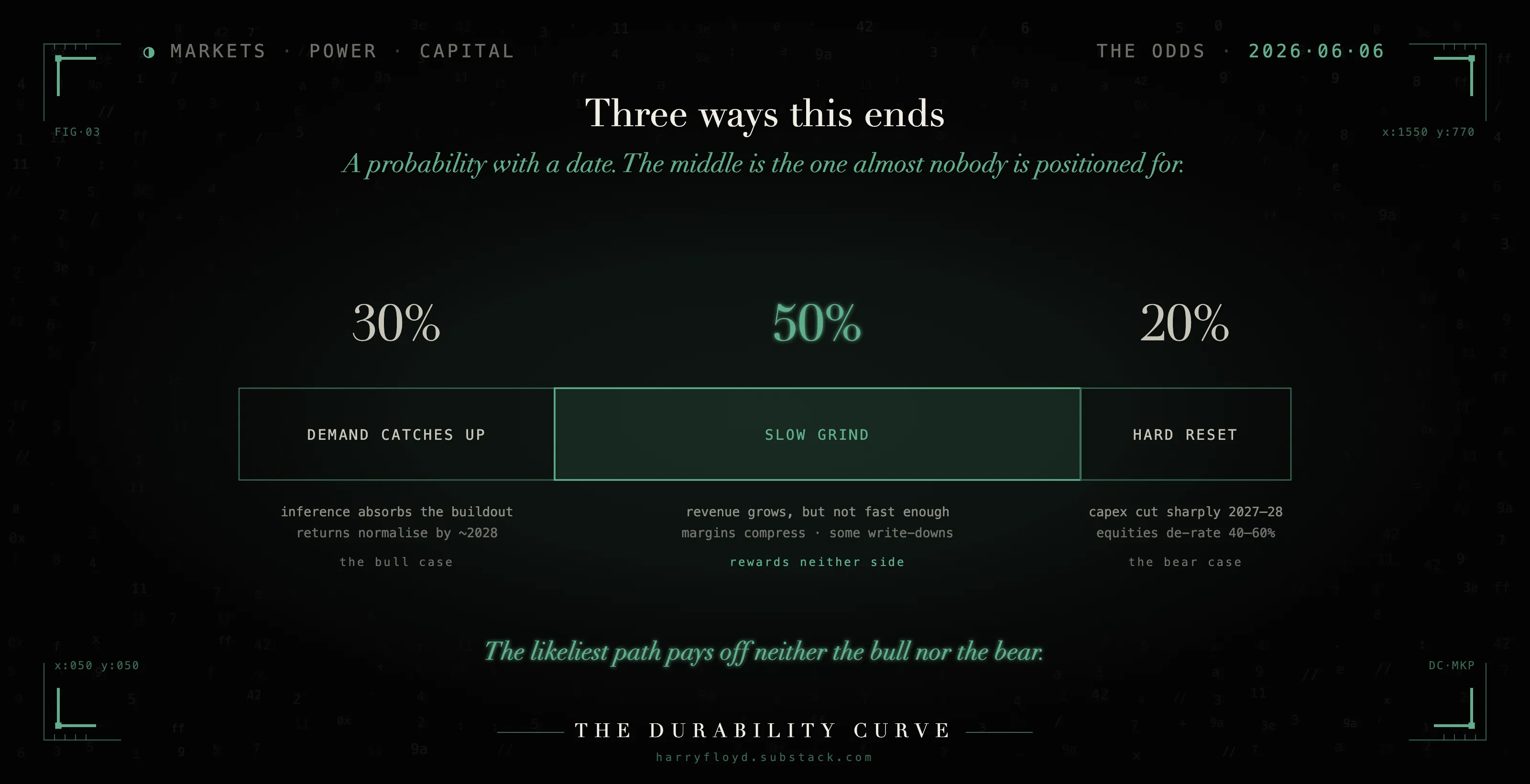
A probability with a date. The slow grind is the unlit middle nobody is positioned for.
What to watch, and the one-week version
The buildout will be real and useful. That was true of the fibre too. The question that decides whether you collect is narrower: does revenue grow into the spending before the spenders lose their nerve, and is your position built to survive the slow grind if it does not.
There is a way to watch the turn instead of guessing at it. Expansion becomes deceleration in advance, in a handful of signals. The master one is guidance: the first time two of the big five trim their capex numbers or soften the language, the regime is changing. Under it, watch for AI revenue growth slipping below fifty percent a year, deployed GPU utilisation falling under half, depreciation schedules stretching, and vendor financing that quietly loops a chipmaker’s money back as a customer’s demand. When three of those fire together, the cycle has turned.
Run the one-week version yourself. Take your largest AI-exposed position and write down why you own it. If the reason is about where the bottleneck sits, you have answered the supply question and skipped the binding one. Re-size it on the return: whether the revenue grows into the spending, and whether the company collects if the buildout takes longer than the bulls promise. Three things would tell me I am wrong, and I am watching all three: AI revenue growth holding above fifty percent and closing the gap by 2027; the hyperscalers sustaining ninety percent of cash flow on capital for two more years while their cloud margins expand; and the 2027 depreciation wave passing with no material write-downs. Any one of those moves the weight toward the clean payback.
Until one of them does, the safest assumption is the one the fibre taught. Being right about the technology and getting paid for it are two different bets. Size the second one.
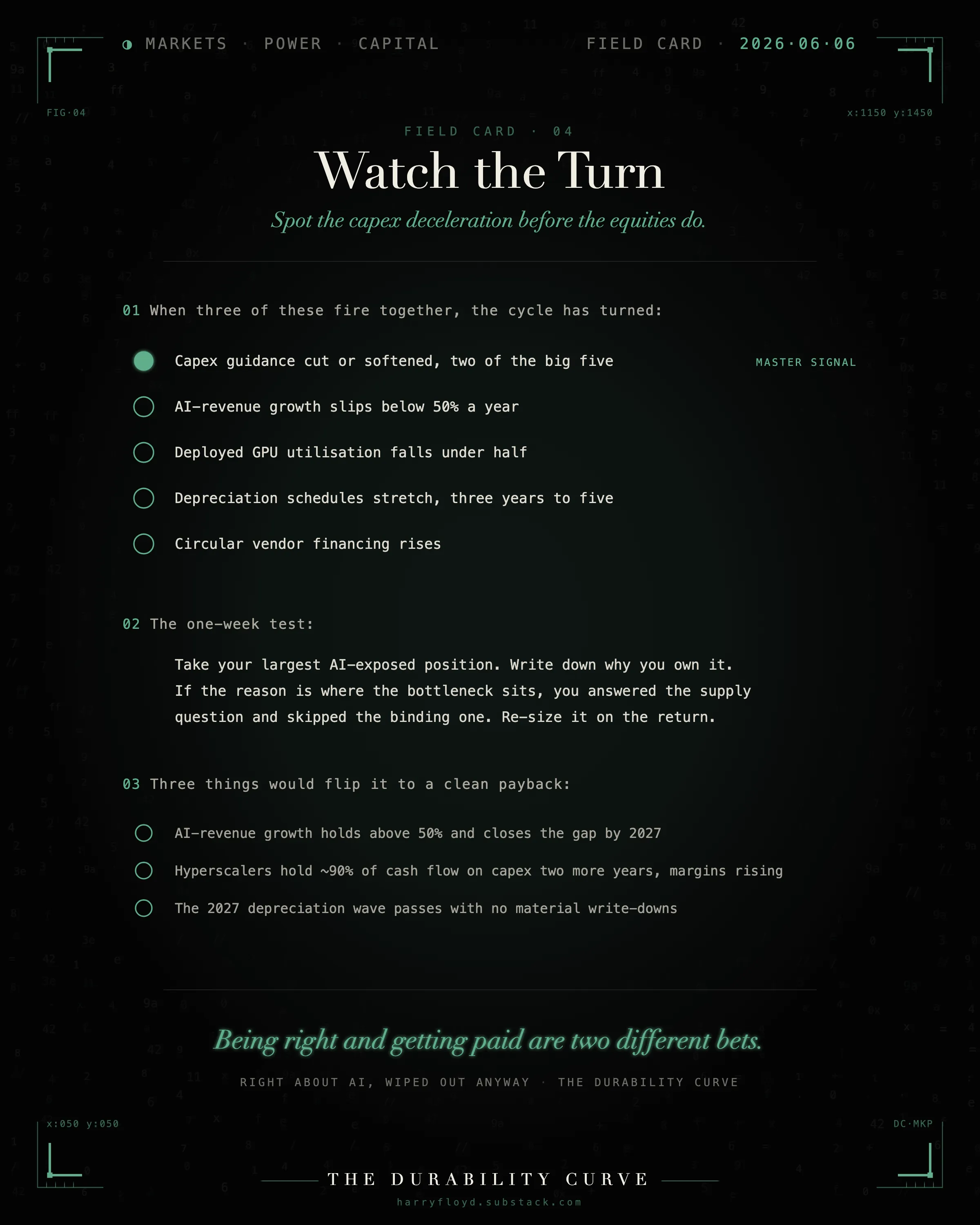
The instrument: watch the composite trigger, then run the one-week test.
Structural reads on the AI cycle, each with an instrument you can run. Free, in your inbox.
Which of your AI positions is sized for the slow grind, and which is quietly betting on the clean payback?
Footnotes
-
In the five years after the Telecommunications Act of 1996, U.S. carriers invested more than $500 billion, mostly debt-financed, laying roughly eighty million miles of fibre (Telecoms crash, Wikipedia). ↩
-
By 2001 about 95 percent of that fibre was dark. Global Crossing filed for bankruptcy in January 2002 with $12.4 billion in debt; WorldCom followed in the summer of 2002. Global telecom equity lost more than $2 trillion in value between 2000 and 2002 (Telecoms crash, Wikipedia). ↩
-
Google, Microsoft, Meta, and Amazon have guided to roughly $725 billion in combined 2026 capital spending, up about 77 percent from the prior year’s $410 billion, in their Q1 2026 earnings (Yahoo Finance). Oracle adds roughly $50 billion more, pushing the five-company total past three-quarters of a trillion dollars. ↩
-
Bank of America estimates the five largest hyperscalers (Microsoft, Amazon, Alphabet, Meta, Oracle) will spend about 90 percent of their operating cash flow on capex in 2026, up from roughly 65 percent in 2025 (MarketWise). ↩
-
Goldman Sachs Research, “Gen AI: Too Much Spend, Too Little Benefit?” (Top of Mind, June 2024), featuring Jim Covello, Head of Global Equity Research, and Daron Acemoglu of MIT; the firm published a further skeptical assessment in May 2026. ↩
-
Roughly nine in ten enterprises now use AI in some form; about three in ten report a clear return (Writer’s 2026 Enterprise AI Adoption Survey, ~29 percent seeing significant ROI); and some 88 percent of agent pilots never reach production (Forrester and Anaconda research, 2026, widely replicated). ↩
-
Several hyperscalers have extended AI-chip depreciation schedules from three years to five (Fortune, April 2026). ↩