How Long Until Your AI Edge Stops Paying?
You adopted AI everywhere and it still didn't pay. The scarce layer keeps the money, until its clock runs out.
The most dangerous AI edge is the one that works. It is real, it is earning money today, and it is commoditising faster than you can build the thing meant to defend it.
Most companies are not even there yet. Nearly every one runs AI somewhere now, and by McKinsey’s 2025 survey almost nine in ten have adopted it while fewer than four in ten can attribute any measurable impact on profit.1 You can read that as a lag, and partly it is: a single quarter’s EBIT is hard to attribute, and some gains really are still coming. But the gap has held too wide for too long to be only timing, and the losing companies run the same models as the winning ones. Same tools, opposite results. The model is not the variable.
The two rates
The variable is a rate. Dario Amodei named the two that matter: two exponentials, one for how fast models improve, one for how fast the economy can absorb them.2 The first is the capability rate. It belongs to the field, and you read it off a press release. The second is your absorption rate: how reliably you turn a new capability into a number your CFO or customer would recognise. You measure that one on purpose, because nobody publishes it for you. When capability outruns absorption, you are stockpiling power you cannot use, and a better model becomes the most expensive way to feel productive that money can buy.
Your absorption rate has a ceiling, and the ceiling is a single layer: the thing a capability has to pass through to reach your customer. For most teams it is mundane, the data nobody has cleaned, the one engineer who understands the legacy system, the customer who will not change how they work, the sign-off that takes three weeks. Whoever owns that layer captures the value, because everything the model can do still has to flow through it. That is the good news, and it is where most advice stops: find the scarce layer, own it, win.
Venice owned the layer, then lost it
History has run this to completion once, with the printing press. Gutenberg built the machine and lost it in a lawsuit to his own financier; the fortunes came downstream, a generation later, in Venice. By 1500 the press was everywhere, which made it cheap, and Venice owned what stayed scarce: the merchant capital to finance a print run, the paper, the Mediterranean routes to move the books, and the literate market to buy them. No rival city held that whole stack at that scale, so the money pooled there, one step downstream of the machine everyone was staring at. Owning the scarce layer worked exactly as promised.
Then it stopped working. As presses, paper mills and booksellers spread across Europe the layer Venice owned stopped being scarce, and over the sixteenth century the lead passed to Paris, Lyon and Antwerp until the trade that built Venice was a junior partner in its own business. The scarce layer had been paying rent the whole time, and the rent had a term. It paid while the layer was hard to copy and went quiet once it was not.
Where the money lands now
The same split is running through AI today, and you can watch where the money lands. Microsoft holds the largest AI distribution in enterprise, and it built that lead by running other companies’ models, OpenAI’s and Anthropic’s, through the channel it already owned: Office, Teams, Azure, and the procurement relationship every large firm already had with it. Around 420 million people use Copilot across Microsoft’s products each month, though only a few per cent pay for it, and the strongest models inside it are still OpenAI’s and Anthropic’s.3 The model was rented, the distribution was owned, and the margin followed the distribution.
That distribution is a slow layer because no model can manufacture a procurement relationship or the switching cost of every enterprise’s existing Microsoft contract, the kind of thing that takes years to build and years to leave. Slow is why it is winning.
Jasper shows the other failure. It raised 125 million dollars4 as a writing tool built on OpenAI’s models, and when ChatGPT arrived free, its product became something anyone could get for nothing overnight. It survived only by climbing into the layer it had skipped, the workflows and data of enterprise marketing teams. Rent the capability and it commoditises on the vendor’s release schedule.
But owning a layer is not enough either, and this is the part the Venice story should have warned you about. Chegg owned its layer outright: a decade-deep library of step-by-step homework solutions and the student traffic to match, a moat no competitor could rebuild quickly. Then a general model could do the whole thing for free. Venice’s edge thinned over a century; Chegg’s broke in a single day. In May 2023 the company told investors that students were leaving for ChatGPT, the stock fell by half, and from its 2021 peak Chegg has since lost more than ninety-five per cent of its value.5
It owned the scarce layer. It owned the wrong one.
The clock decides
Put Venice and Chegg side by side and you see the variable. Same kind of edge, a scarce layer others had to pass through, and the clocks ran a hundredfold apart: Venice’s lasted a century, Chegg’s lasted months. That turns owning a scarce layer from an answer into a question. The rule is an inequality. A scarce layer pays only if its clock is longer than the time it takes you to build on it. Clear that bar and you compound; miss it and you have bought a melting asset at full price. So the target is a layer that is both scarce and slow, and the discipline is to read both before you commit.
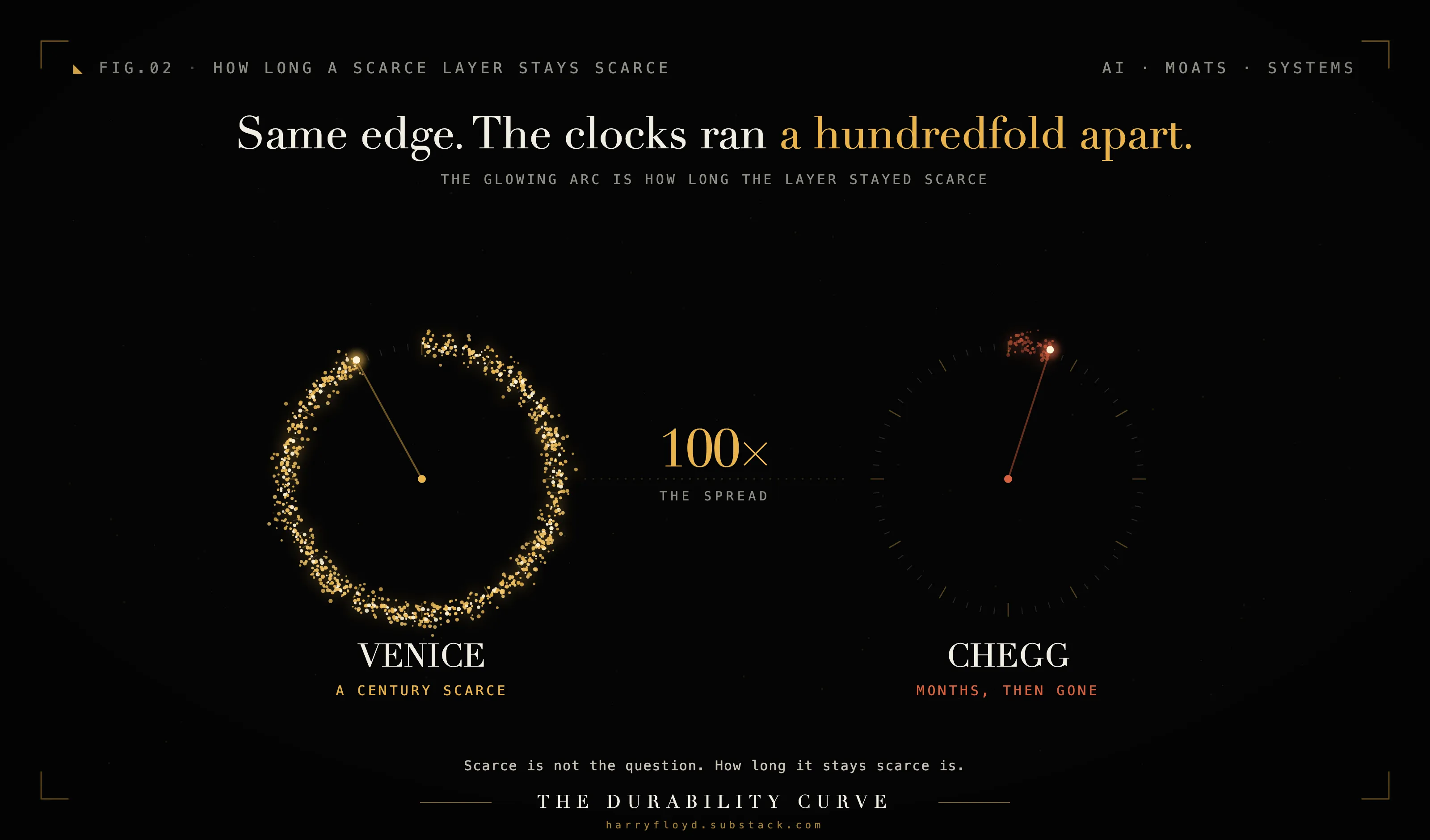
FIG.02 · Venice’s layer stayed scarce for a century; Chegg’s, for months. The same kind of edge, a hundredfold apart.
What sets the term? A layer’s clock is short when a general model can absorb it: a clever technique, a prompt chain, a fine-tune, generic data anyone can assemble. It is long when the scarcity rests on something a model cannot manufacture, a regulator’s approval, a physical bottleneck like fabs or power, years of accumulated switching cost, a trust relationship a customer will not casually move. Chegg’s layer was content a model could regenerate, so it had only months. The chips an AI runs on are a physical bottleneck, so their scarcity holds for years.
Even that one is eroding. Nvidia owns roughly four-fifths of the merchant AI-accelerator market6 and charges a toll most industries never see, the hardest layer in the stack, yet its largest customers are designing their own silicon to route around it. The gross margin will bend before the share does: a credible in-house alternative lets a big customer negotiate the price down long before it moves enough volume to dent Nvidia’s share. Since this essay asks you to read your own clock, here is mine, on the record. Nvidia’s margin, in the mid-70s today, is the first thing that should crack. I expect it below 70% by 2028. If it still holds in the high-70s by then, the compute layer is more durable than this rule predicts, and you should trust the rest of this less.
The capability rate is the master clock behind them all. When models jump, every layer’s scarcity shortens at once, and it cuts the other way too: the same jump that shortens your clock also speeds your build. The bet survives only when capability erodes your moat slower than it accelerates your payback. Nothing here stays still, so re-price it every time the models move.
The clock can sound like weather, something you forecast and brace for. But you can also wind it. The same properties that make a layer hard for a rival to copy make it hard for a model to absorb, and you can add them on purpose: bind it to a switching cost, to a regulator’s sign-off, to a governed data estate no model can cleanly or legally reproduce. The strongest players read their clock and then lengthen it. Chegg could not, because homework answers have nowhere to hide; a layer with somewhere to hide is one you can defend.
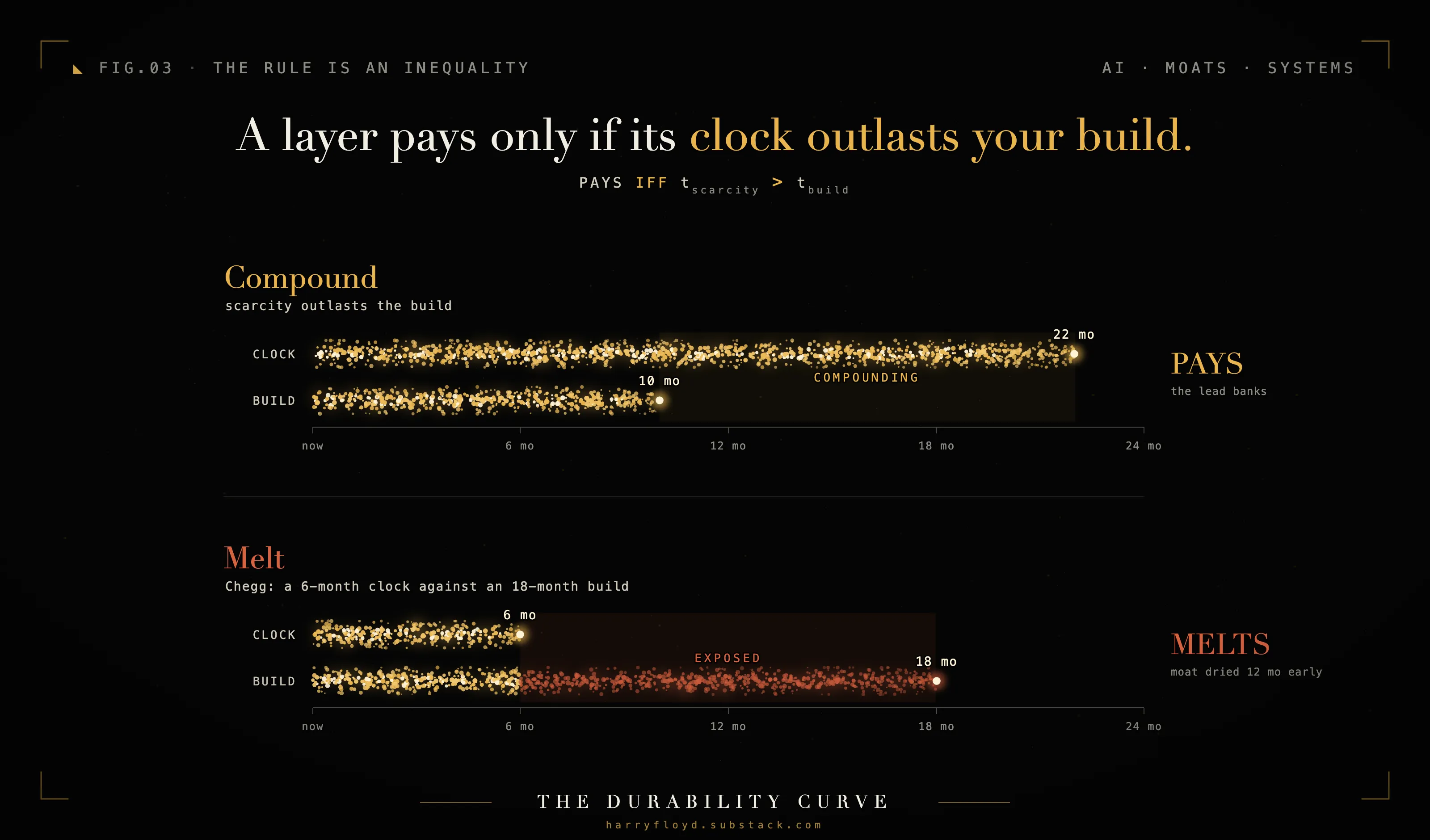
FIG.03 · A scarce layer pays only if its clock outlasts your build. Chegg owned a real moat with a six-month clock and bet an eighteen-month build on it.
Run it on your own layer
So the work is concrete, and it fits on one page. First, name your absorbing layer. Use the doubling test: what, if it doubled tomorrow, would let you use twice as much model, while doubling the model itself bought you nothing more? That is the thing capping you. Name the real one before you spend another dollar on capability.
Second, test whether you own it. The bar is strict. You own a layer only when a new capability cannot reach your customer without passing through something of yours that a rival cannot rebuild in a weekend. A model fine-tuned on your own documents does not pass. A workflow your customer could swap out over a weekend does not pass. Run the test before the market runs it for you, because most teams are standing on a layer they only believe they own.
Third, measure your absorption rate. Count the capabilities you seriously tried this year and the ones that moved a number your CFO or customer would recognise; that ratio is your hit rate. Say you ran nine pilots and two produced a result your CFO actually tracked. Two in nine, and the other seven were the model outrunning your ability to use it. Treat the figure as soft, for two reasons. Try three things and you have an anecdote, so work from a real list. And “moved a number” carries an attribution problem, the same one that makes the headline surveys shaky, so keep the credit you can actually trace and discount the rest. The exact ratio matters less than the read: most of what you tried means you are keeping up, almost none means the model is lapping you. The first honest reading usually stings, because the year went on buying the fast curve while the slow one sat untouched.
Fourth, read both clocks. Estimate how long your layer stays scarce, short if a model can absorb it, long if it is gated by something a model cannot make. Then estimate your payback, how long a build on that layer takes to earn back what it costs. If the clock is shorter than the payback, you are Chegg, standing on a real moat that melts before it pays, and the move is to lengthen that clock if you can and build toward a slower layer if you cannot. If it is longer, you have room, and a low hit rate is an organisational problem: give the capability you already have a single owner and a single metric, and hold it before you buy more.
Run it on a shape you can picture, and let it bite. Take a forty-person logistics company with three years of messy carrier-integration data no rival has cleaned: double the data and the model gets more useful, double the model and nothing changes, so the data is the layer. Nobody rebuilds three years of dirty feeds in a weekend, so they own it, and two of their nine pilots moved a number the CFO tracked. Every test passes; last year the read was room to compound. Then the clock moved under them: a frontier model shipped that parses raw carrier feeds zero-shot, and three years of cleaning collapsed into a prompt. The layer that looked like years of scarcity now had six months, against an eighteen-month build. The bet flipped from compound to melting while the data sat untouched, because the capability rate cut the clock faster than they could build. Re-run the number the moment a model moves.
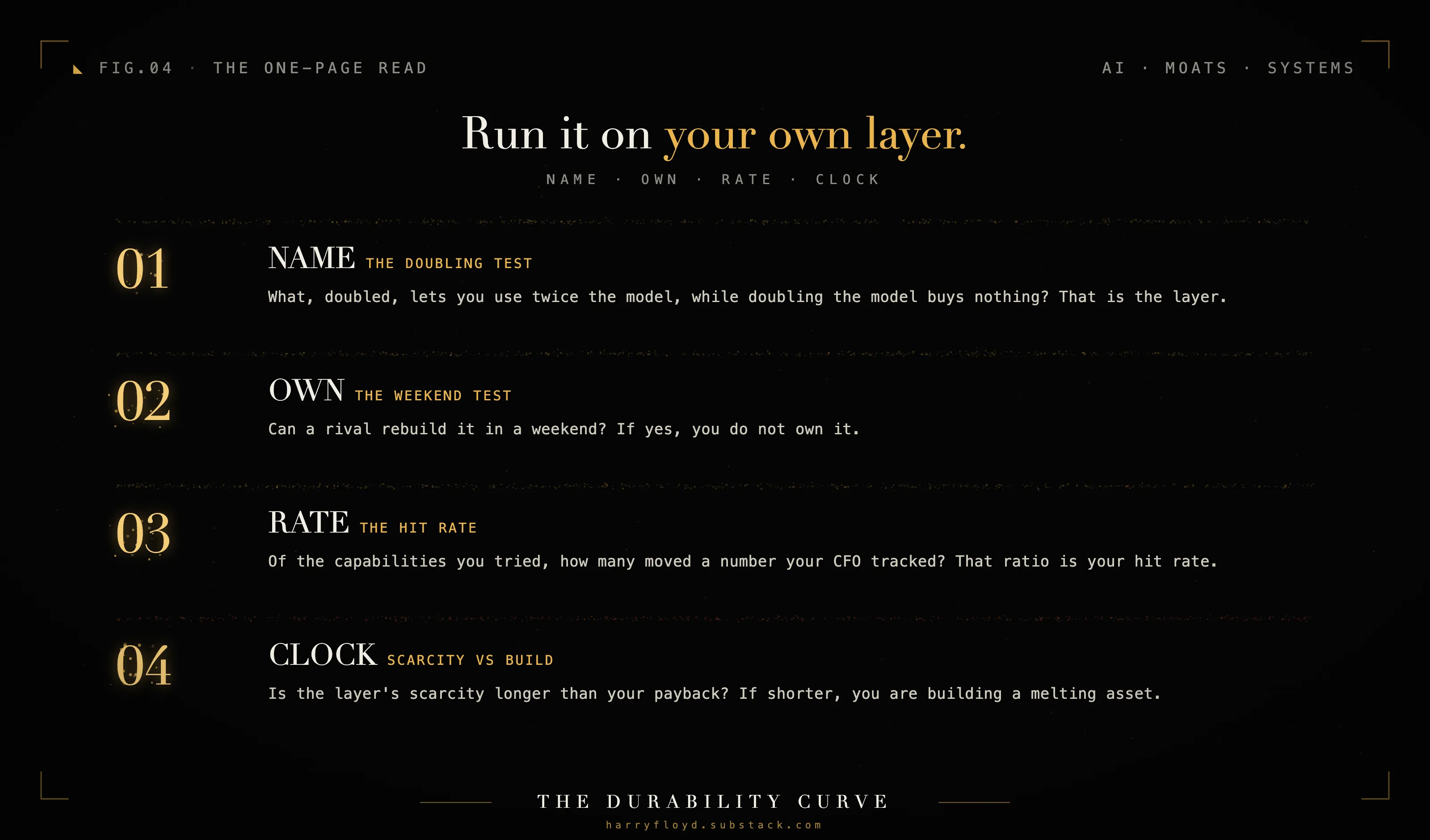
FIG.04 · The whole diagnostic on one page: name the layer, test ownership, measure your hit rate, read both clocks.
Gutenberg kept the craft. Venice kept the money, until the layer it owned stopped being scarce. Chegg owned its layer right up to the morning it stopped being worth owning. No layer stays slow forever, because the capability rate is coming for all of them. The fortune goes to whoever owns a layer slower than that, and keeps checking whether it still is.
So: how many months of scarcity does your layer have left, and how long is the build you are spending them on?
You can put real numbers on both. The Two-Rate Diagnostic runs the read in your browser: name your layer, and it returns your absorption rate, the layer’s half-life, and the date to start building the next one.
The clocks keep moving, so any read has a short shelf life. The instruments and essays here keep tracking them, sourced and dated, as the signals move. Subscribe to stay current.
Footnotes
-
McKinsey, The State of AI (2025): 88% of organisations report using AI in at least one business function, while only 39% can attribute any EBIT impact to it. https://www.mckinsey.com/capabilities/quantumblack/our-insights/the-state-of-ai ↩
-
Dario Amodei, in conversation with Dwarkesh Patel, describes two exponentials: one for the capability of the models, and a slower downstream one for the economy diffusing them. https://www.dwarkesh.com/p/dario-amodei-2 ↩
-
Microsoft reports roughly 420 million monthly active Copilot users across its products; paid Microsoft 365 Copilot seats had reached about 20 million against some 450 million commercial users, around 4 to 5%. TechCrunch, April 2026. https://techcrunch.com/2026/04/29/microsoft-says-it-has-over-20m-paid-copilot-users-and-they-really-are-using-it/ ↩
-
Jasper announced a $125 million Series A in October 2022. SiliconANGLE. https://siliconangle.com/2022/10/18/jasper-raises-125m-series-funding-ai-powered-content-creation-smarts/ ↩
-
Chegg shares fell about 48% on 2 May 2023 after it warned that students were leaving for ChatGPT; from its February 2021 peak of $113.51 the stock is down roughly 99%. Fortune. https://fortune.com/2023/05/02/chegg-shares-tumble-students-fleeing-chatgpt-a-i/ ↩
-
NVIDIA’s first-quarter fiscal 2027 results, reported 20 May 2026, show GAAP and non-GAAP gross margin of 74.9% and 75.0%. Its share of the merchant AI-accelerator market is widely estimated near four-fifths, expected to ease toward 75% as customers’ own silicon scales. https://nvidianews.nvidia.com/news/nvidia-announces-financial-results-for-first-quarter-fiscal-2027 ↩